
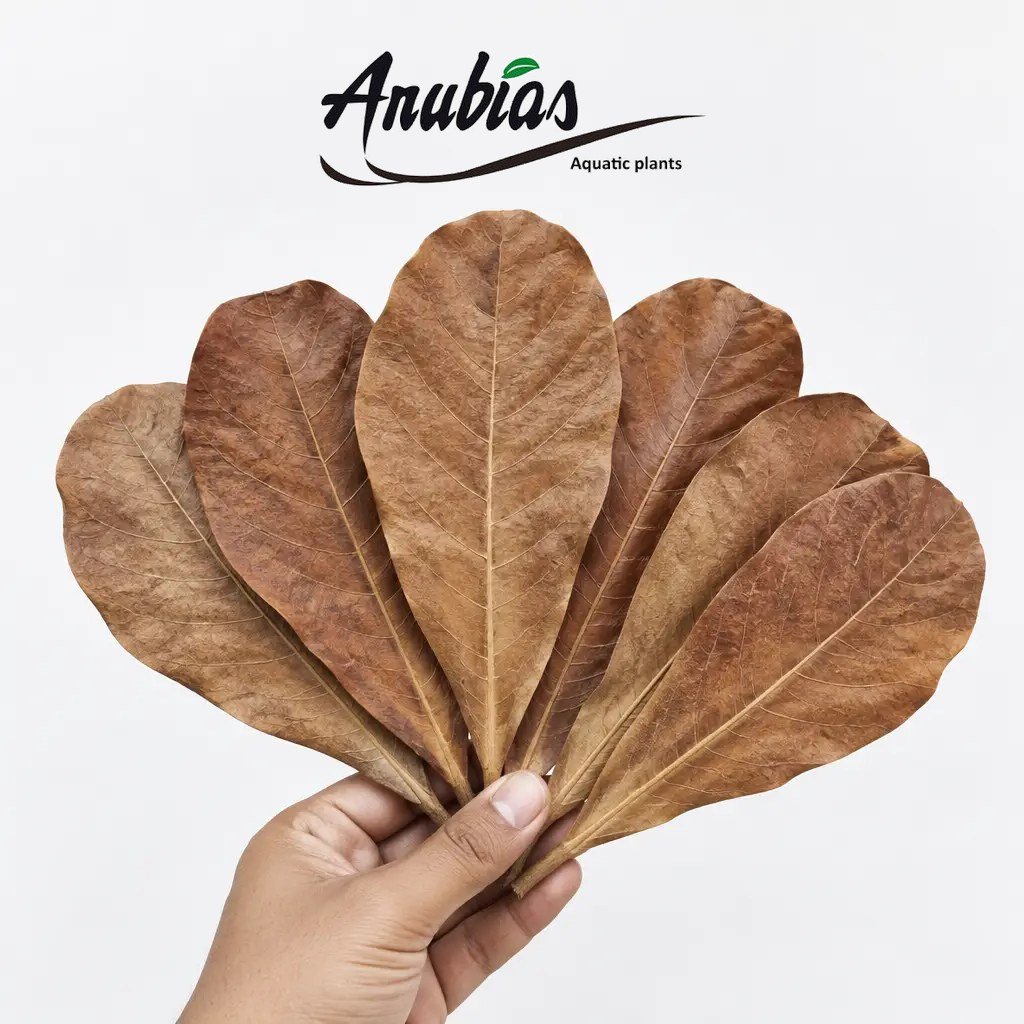
Description
Indian almond leaves (Terminalia catappa), also called catappa leaves or ketapang, are the dried leaves of the tropical almond tree that grows along the Indian and Southeast Asian coast. Dropped into an aquarium they slowly release tannins and humic substances that tint the water a soft tea colour, lower the pH a little, soften the feel of the water and create the blackwater conditions that bettas, gouramis, tetras and many shrimp come from. Indian almond leaves suit betta keepers who want darker, calmer water, shrimp breeders who want a biofilm surface for shrimplets to graze, and anyone keeping fish from soft, acidic streams who wants a natural, inexpensive way to recreate that habitat.
Indian almond leaves at a glance
| Scientific name | Terminalia catappa (tropical almond, sea almond, ketapang, badam) |
|---|---|
| Family | Combretaceae |
| Origin | Coastal India, Southeast Asia, northern Australia and the Pacific; the leaves are gathered after they fall naturally |
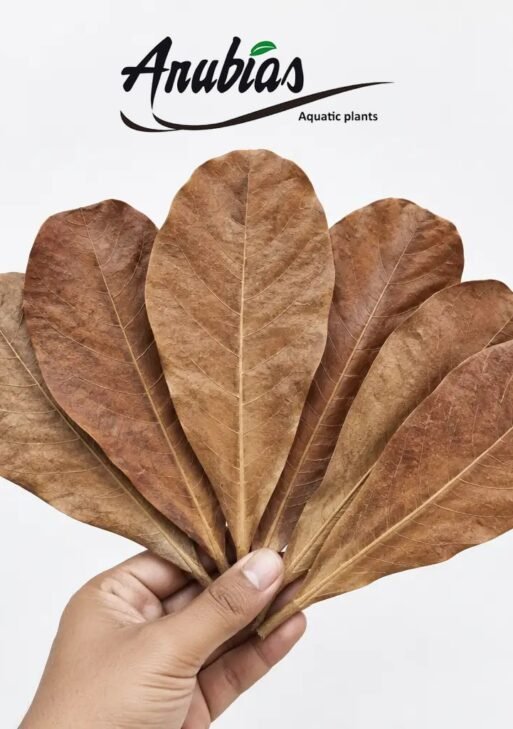
| Form | Whole sun-dried leaves, no chemicals |
| Pack sizes | 10, 25 or 50 leaves |
| Dose | About one leaf per 10–20 litres |
| Effect on water | Light amber tint; pH drops slightly (more in soft water, very little in hard water) |
| Best for | Bettas, gouramis, tetras, rasboras, apistogramma, caridina and neocaridina shrimp, fry tanks |
| Replace | Every 2–4 weeks as the leaf breaks down |
| Safe with | All fish, shrimp and snails; not for use in tanks where you need crystal-clear water |
How to use Indian almond leaves
There is no planting; the leaves work just by sitting in the water.
- Rinse each leaf briefly under tap water to remove dust.
- Choose your method. Drop the leaf in dry and it floats for a day or two before sinking as it soaks. Or boil it for two or three minutes and add the cooled leaf and the tea-coloured water for a faster, stronger release.
- Start with one leaf per 10–20 litres. For a 15-litre betta tank that is a single leaf; for a 60-litre community tank, three or four.
- Leave the leaf where fish and shrimp can reach it. Bettas often rest on a sunken leaf, and shrimp swarm over it as biofilm forms.
- After two to four weeks the leaf softens and turns skeletal. Remove it or let the shrimp finish it, then add a fresh one.
To prepare blackwater for water changes, steep a few leaves in a bucket of tap water for 24 hours and use that water for the next change. This keeps the tint steady rather than swinging with every change.
What the leaves do in the tank
Tannins and tint. As the leaf soaks it releases tannins, humic and fulvic acids. These colour the water amber, soften the harsh look of bright lighting and give fish a dimmer, more natural environment. Many bettas colour up and become more active in tinted water simply because they feel less exposed.
pH and hardness. The acids lower pH a little. In soft or RO water the drop can be half a point or more; in hard Indian tap water with high KH the buffering absorbs most of it, so expect only a small change. If you need a real pH shift in hard water, the leaves alone will not do it.
Biofilm and grazing. Within days a film of bacteria and microorganisms grows on the leaf. Shrimp, snails and fry graze it constantly, which makes almond leaves a standard addition to shrimp breeding tanks.
Shelter and spawning. A sunken leaf is a hide for shrimplets and fry, a resting spot for bettas and a spawning surface for apistogramma and some killifish. Betta breeders often float a leaf so the male can build his bubble nest beneath it.
Indian almond leaves are widely used in blackwater keeping and are a traditional part of betta husbandry. They are a habitat and water-conditioning product; they are not a medicine and should not replace treatment for a sick fish.
Dosing, tint and replacement
The tint builds over a few days and fades over the following weeks as the leaf exhausts its tannins and water changes dilute it. If the water goes darker than you like, use fewer leaves, do a larger water change or run activated carbon for a day or two. If you want it darker, boil the leaves first or add one more.
Replace leaves every two to four weeks. In a shrimp tank you can leave the old leaf until it is grazed to a skeleton; in a betta or community tank remove it once it turns mushy. A 10-leaf pack lasts a small betta or shrimp tank around two months; the 25 and 50 packs suit multiple or larger tanks.
Which tanks benefit most
Betta tanks of 1 ft (15–20 litres) are the classic use: one leaf, replaced monthly, gives the fish a dim, calm home. Shrimp tanks of 1–2 ft (20–60 litres) gain a constant grazing surface; pair the leaves with Anubias nana for more biofilm surfaces. Blackwater biotopes of 3–4 ft (100–200 litres) with tetras, rasboras, gouramis or wild bettas take several leaves, often with driftwood and floating plants to complete the shaded look. Cryptocoryne and Java fern grow happily in tannin-stained water.
Skip the leaves in tanks where you want crystal-clear water and in African cichlid tanks that need hard alkaline water.
Common problems and fixes
- Water too dark. Cause: too many leaves or boiled leaves in a small tank. Fix: remove a leaf, do a 30% water change, or run activated carbon briefly.
- Leaf floats and will not sink. Normal for a dry leaf. It sinks in a day or two; boil it or weigh it down with a stone for instant sinking.
- White fuzz on the leaf. Harmless fungus or biofilm that appears in the first week. Shrimp and snails eat it; it clears on its own.
- Foam or oily surface film. Cause: organics from fresh leaves. Fix: increase surface agitation slightly or skim with a paper towel.
- pH barely changes. Cause: hard, well-buffered tap water. Expected; the leaves still provide tint, biofilm and shelter.
- Leaf disintegrates quickly. Normal in warm, shrimp-heavy tanks; replace as needed.
What you receive
One pack of sun-dried Indian almond leaves in the pack size you select (10, 25 or 50 leaves), similar to the photo, with no chemicals or treatments. Each pack is checked before packing and shipped across India from Surat. ₹99 shipping, free on orders of ₹999 or more.
If your pack arrives damaged, record one continuous unboxing video within 4 hours of delivery and we will refund or replace it.
FAQ
How many Indian almond leaves should I use?
About one leaf per 10–20 litres. One leaf for a betta tank, three or four for a 60-litre tank. Adjust by the tint you want.
Are Indian almond leaves good for bettas?
Yes. They tint and dim the water, give bettas a leaf to rest on and a surface for bubble nests, and recreate the soft, shaded water bettas come from.
Do Indian almond leaves lower pH?
Slightly. The drop is noticeable in soft water and very small in hard, high-KH tap water. They are not a tool for large pH changes.
How long do Indian almond leaves last in the tank?
Two to four weeks. The tannins release over the first week or two and the leaf softens after that. Replace it when it turns mushy.
Are Indian almond leaves safe for shrimp and snails?
Yes. Shrimp and snails graze the biofilm that forms on the leaf, and the leaf gives shrimplets a hiding place.
Should I boil Indian almond leaves before use?
Optional. Boiling for two or three minutes sinks the leaf immediately and releases tannins faster; adding it dry gives a slower, gentler release.
Will Indian almond leaves make my water cloudy?
No. They tint the water amber but keep it clear. Cloudiness has another cause, usually a bacterial bloom.
Not sure what fits your tank? Plan it with our free AI tank planner.










There are no reviews yet.