

Brazilian pennywort (Hydrocotyle leucocephala) is one of the easiest aquarium plants you can buy. Its round, bright green leaves grow on long trailing stems that can be planted, tied to wood or simply left floating. It grows fast, soaks up nutrients and gives fish plenty of cover.
Quick answer: Brazilian pennywort is a very easy, fast-growing plant that grows in low to high light without CO2 at 20–28 °C. You can plant the stems in the background, let them trail across the surface, or float them loose. Trim weekly to stop it shading other plants; its fast growth helps reduce algae by using up excess nutrients.
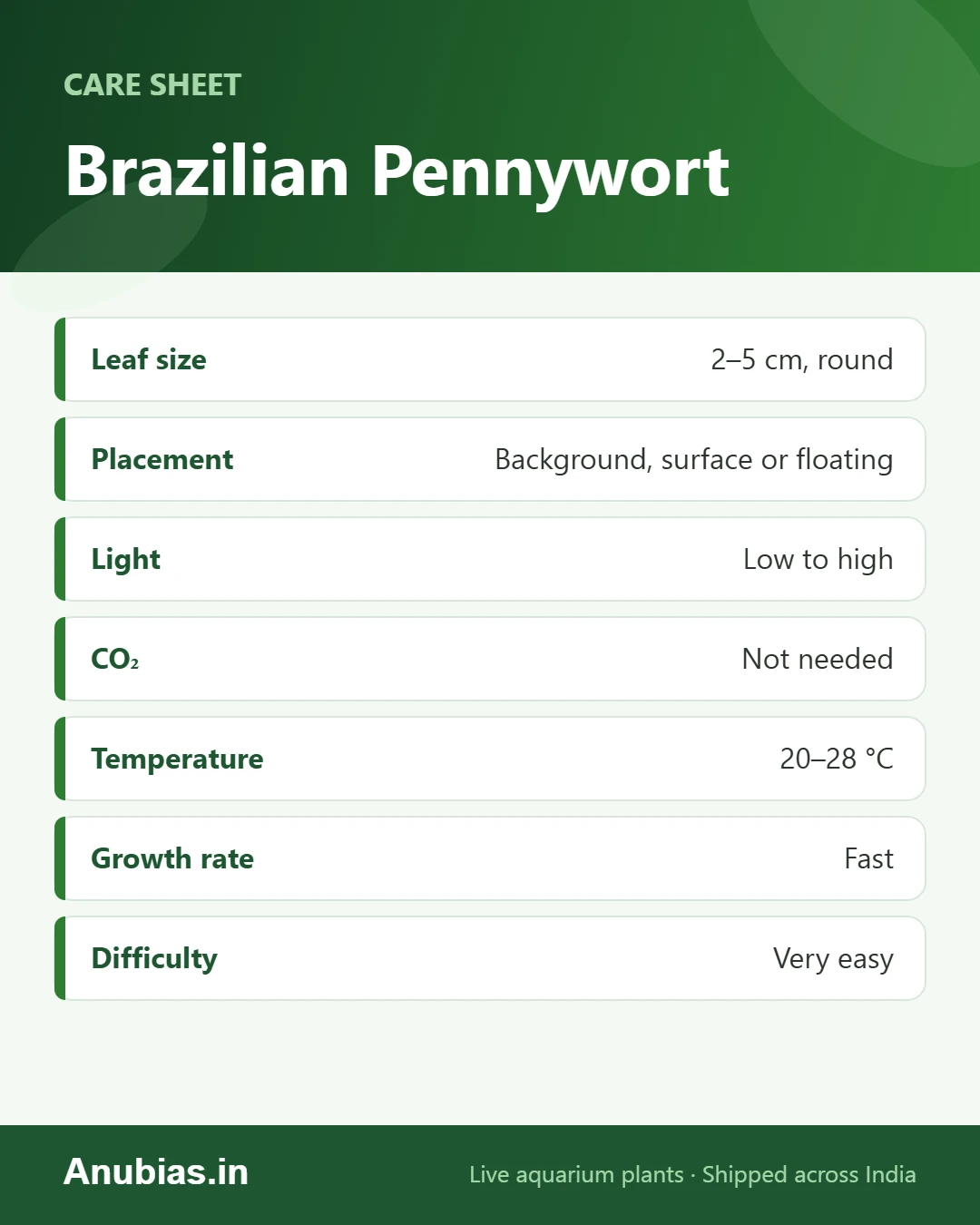
Brazilian pennywort care sheet
| Parameter | Recommendation |
|---|---|
| Scientific name | Hydrocotyle leucocephala |
| Origin | South America |
| Leaf size | 2–5 cm, round |
| Placement | Background, surface, or floating |
| Light | Low to high |
| CO₂ | Not needed |
| Temperature | 20–28 °C |
| Growth rate | Fast |
| Difficulty | Very easy |
| Price in India | From ₹80 on Anubias.in |
Floating vs planted: which is better?
Both work, and each gives a different look. Floating pennywort grows fastest because it sits close to the light, creating a shady canopy with hanging roots for fry and shrimp. Planted in the substrate, it grows upward in a vertical line and then spreads across the surface. Many keepers plant the base and let the tops trail naturally.
Uses in the aquarium
- Algae control: absorbs nitrate quickly. See plants that reduce algae.
- Shade: dims strong light for Anubias and Crypts below.
- Fry and shrimp cover: dense roots and leaves.
- New tank helper: fast growth stabilises water in the first weeks.
- Outdoor tubs and ponds: grows well in partial shade.
Trimming and common problems
- Taking over the surface: remove extra stems weekly; leave open water for surface-breathing fish.
- Leggy stems with small leaves: light too low for planted stems; let tops float.
- Yellow leaves: nutrient shortage in lightly stocked tanks; add liquid fertiliser.
More floating plant guides:
- Amazon Frogbit vs Water Lettuce vs Duckweed
- Keeping Aquatic Plant Tubs Mosquito-Free in India (Monsoon Guide)
- Best Plants for Outdoor Tubs, Urli Bowls and Balcony Ponds in India
- Amazon Frogbit Care Guide
- Water Hyacinth (Eichhornia crassipes) Care Guide
- Water Lettuce Care Guide
- Duckweed Care Guide
- Floating Plants for Aquariums
Brazilian pennywort in Indian tanks
This is one of the easier plants to keep across Indian conditions, largely because it spends much of its time at or near the surface where light is strongest and oxygen exchange is best.
Heat is handled reasonably well. Floating pennywort tolerates water in the high twenties without complaint, and because leaves sit at the surface it can push growth into the air when submerged conditions get uncomfortable. In prolonged 30°C-plus spells you may see thinner stems and smaller leaves, which recover once temperatures drop.
Hard tap water suits it. Pennywort is not fussy about hardness or pH, so most municipal and borewell supplies in India are fine without treatment beyond dechlorination.
The genuine risk is the opposite of neglect. In a well-lit tank with fish waste to feed on, it grows fast enough to cover the entire surface in a few weeks, shading everything below it. Treat trimming as a scheduled job, not something you do when it looks untidy.
Starting a new batch from cuttings
- Choose a healthy stem with at least four or five leaves and visible roots at the nodes.
- Cut just below a node using clean scissors, leaving the parent stem intact so it branches.
- Strip the lowest one or two leaves if you plan to plant it in substrate; leave them if it will float.
- For floating, simply lay the cutting on the surface. It will root into the water column within days.
- For planting, push the bare node two to three centimetres into the substrate and weight it lightly until it anchors.
- Keep the new cutting in good light for the first fortnight so it establishes before you start trimming again.
Cuttings travel well, which makes pennywort a good plant to share with other hobbyists. Post it wrapped in damp tissue inside a sealed bag rather than in water, and avoid posting during peak monsoon when parcels sit longer in transit.
Plants in this guide
Grown in Surat · graded by leaf count and photographed before dispatch · live-arrival guarantee on every order · ₹99 shipping, free from ₹2,000


Frequently asked questions
Is Brazilian pennywort good for goldfish?
Partly. Goldfish may nibble it, but it grows fast enough to survive in many goldfish tanks and ponds.
Can Brazilian pennywort grow out of water?
Yes, it grows emersed along pond edges and in paludariums.
How is it different from Hydrocotyle Tripartita?
Brazilian pennywort has large round leaves and tall or floating growth; Hydrocotyle Tripartita has tiny leaves and creeps as a carpet.
Buy Brazilian Pennywort or see all floating plants, shipped across India with a live-arrival guarantee.
Does Brazilian pennywort need fertiliser?
Not in a stocked tank, where fish waste usually supplies enough nitrogen and phosphate for it. It becomes worth dosing a liquid fertiliser in lightly stocked or newly set-up tanks, where yellowing older leaves signal shortage. Because it is fast growing, it will use iron and micronutrients readily if you offer them.
Will it survive an unheated tank through winter?
Yes in most of India, where indoor tank temperatures rarely drop far enough to harm it. Growth slows noticeably in cooler water and the plant may look sparse for a few weeks, which is normal rather than a sign of trouble. In genuinely cold northern winters, keep it floating where the water is warmest.
Why are my pennywort stems growing sideways along the glass?
Because the stems are chasing light across the surface once they reach the top of the water. This is normal behaviour for the plant, not a defect. If you want a more upright look, plant the stems in substrate towards the back and trim the tops before they reach the surface.