
Description
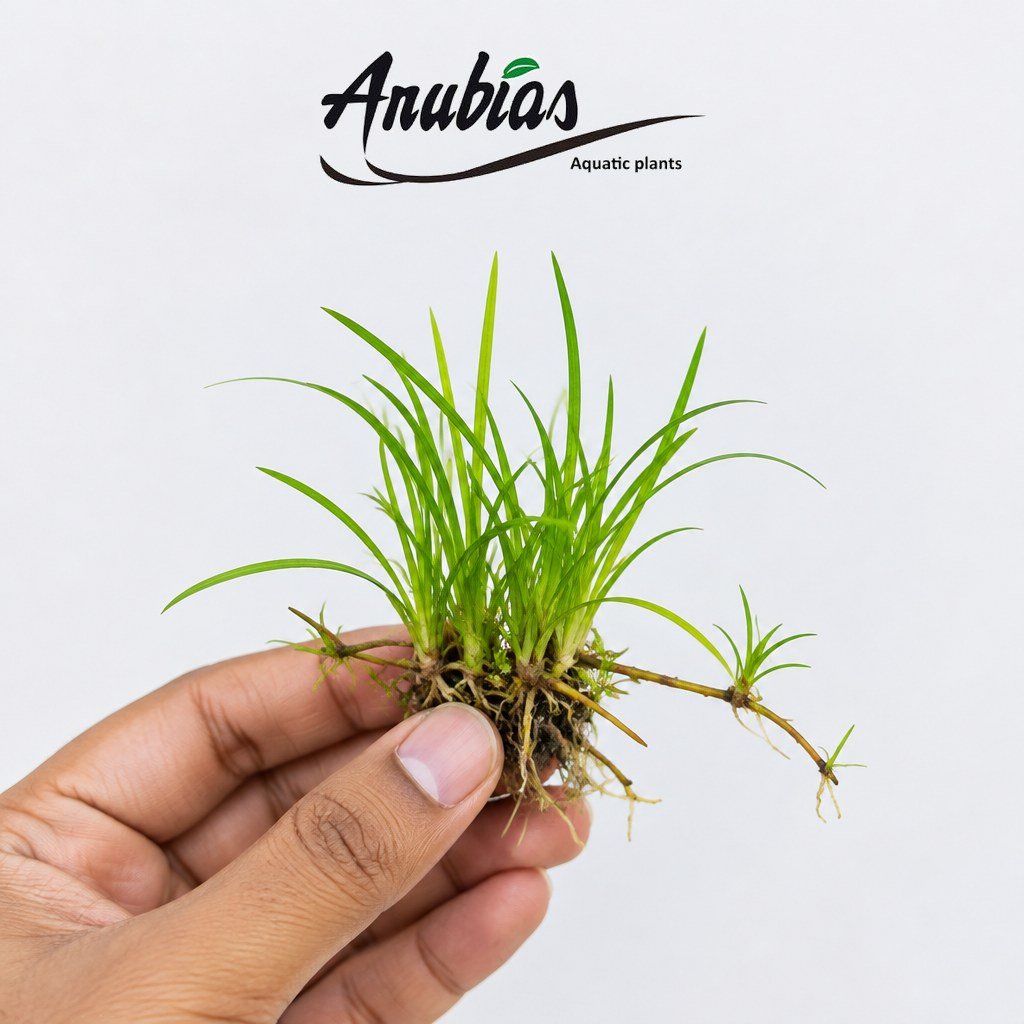
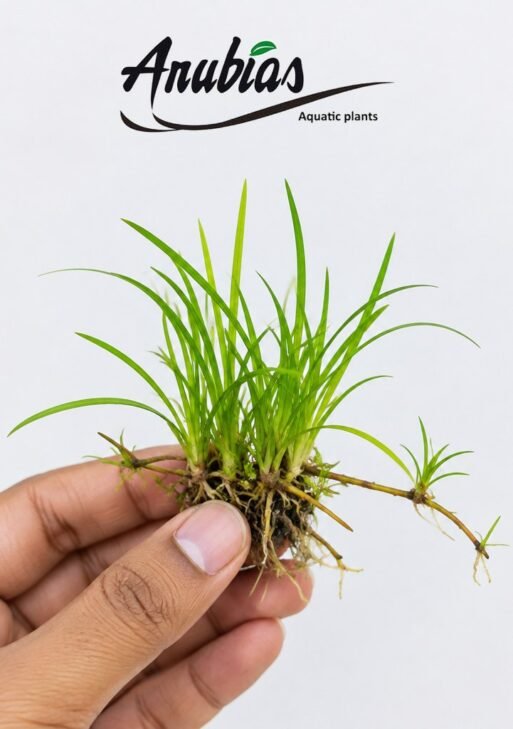
Echinodorus tenellus, the Pygmy Chain Sword, is a grassy foreground plant from the Americas that spreads by runners into a dense lawn 5–10 cm tall. Despite the amazon sword family name, it looks nothing like its large relatives: the leaves are narrow blades that turn bronze under strong light, and new plants pop up in a chain along each runner. Echinodorus tenellus is one of the easiest carpeting plants for Indian aquarists because it grows in hard water, tolerates moderate light and does not insist on CO2.
Echinodorus tenellus at a glance
| Scientific name | Echinodorus tenellus (now Helanthium tenellum) |
|---|---|
| Family | Alismataceae |
| Origin | North, Central and South America |
| Difficulty | Easy |
| Light | Medium (tolerates low; bronze tint under high) |
| CO2 | Optional; speeds carpeting |
| Temperature | 20–28 °C |
| pH | 6.0–7.8 |
| Growth rate | Moderate to fast |
| Height/size | 5–10 cm tall, leaves 2–4 mm wide |
| Placement | Foreground carpet |
| Propagation | Runners (chains of daughter plants) |
How to plant Echinodorus tenellus
- Rinse the portion and separate it into individual plantlets or small groups of two or three, each with roots.
- Trim the roots to about 1.5–2 cm.
- Use fine tweezers to push each plantlet into the substrate, roots buried and crown at the surface. Angle the tweezers so the plant does not pull out when you release it.
- Space plantlets 2–3 cm apart in a grid across the foreground. Closer spacing means a faster carpet.
- Use fine substrate (sand or small-grain aquasoil) so runners can push through easily. Add root tabs in inert substrate.
Echinodorus tenellus care: light, CO2, fertiliser and water
Light. Medium light gives a dense, low carpet. Under low light the plant survives and spreads slowly with taller, greener leaves; under high light it stays very short and turns bronze-red. Aim for a photoperiod of 7–8 hours.
CO2. Optional. Without CO2 a carpet takes two to four months to close; with CO2 it can close in four to six weeks. Liquid carbon helps a little in low-tech tanks.
Fertiliser. Root tabs spread across the carpet area every three months in sand or gravel, or aquasoil, plus a weekly liquid fertiliser. Pale, yellowish new growth means iron shortage.
Water. Tolerant of hard Indian tap water up to pH 7.8. Regular 25–30% water changes keep the carpet clean and nutrient levels steady.
Indian conditions. Comfortable at 28 °C; above 30 °C growth slows, so keep surface movement and use a fan in peak summer. Monsoon power cuts of a few hours do not harm it.
Growth, trimming and propagation
Once rooted, each plantlet sends out runners within two to three weeks, and each runner produces a chain of new plants. A well-lit, well-fed foreground closes in two to four months without CO2.
Trimming keeps the carpet low. Every month or two, cut the tallest leaves back with curved scissors and siphon the trimmings. Thin dense patches by lifting a few plants so light reaches the base. Runners that stray into the midground can be cut and pulled out.
Propagation is automatic. To start a new patch, lift a chain of daughter plants, cut the runner between them and replant.
Where to use it in an aquascape
Echinodorus tenellus is a foreground carpet for tanks from 1.5 ft (40 litres) up to 4 ft (300 litres) and beyond. It gives a natural, grassy meadow look that suits nature-style and biotope layouts better than the perfectly flat carpets of Monte Carlo or dwarf baby tears. It also works as a transition between a bare sand path and taller plants.
Behind it, use plants from our Cryptocoryne collection and stem plants, with Anubias nana and Java fern on hardscape. Browse our other carpeting plants if you want to mix textures.
Ideal for shrimp tanks and small fish such as tetras, rasboras and Corydoras, which forage through the grass. Avoid diggers and goldfish, which uproot the runners.
Common problems and fixes
- Plantlets floating up after planting. Roots too short or substrate too coarse. Replant deeper and plant at an angle; it holds once runners spread.
- Old leaves melting after planting. Emersed leaves are replaced by submerged ones in the first two weeks. Normal; leave the roots in place.
- Carpet growing tall and thin. Light too low. Increase intensity or reduce the distance to the light.
- Pale or yellow leaves. Iron deficiency. Dose chelated iron and add root tabs.
- Hair algae in the carpet. Light too strong for the available CO2 and nutrients. Shorten the photoperiod, add Amano shrimp and trim affected leaves.
- Carpet spreading into the wrong areas. Normal for a runner plant. Cut and remove runners along the edge monthly.
What you receive
You receive one healthy portion of Echinodorus tenellus in the size you select (Small or Standard), similar to the one in the photo. It is checked before packing, wrapped moist and shipped across India from Surat. Live-arrival guarantee: record one continuous unboxing video within 4 hours of delivery and we refund or replace any plant that arrives damaged.
FAQ
Does Echinodorus tenellus need CO2?
No. It carpets without CO2 under medium light, taking two to four months to close. CO2 roughly halves that time.
Is the Pygmy Chain Sword good for beginners?
Yes. It is one of the easiest carpeting plants, tolerant of hard water and moderate light, and it spreads on its own by runners.
Can Echinodorus tenellus grow in sand?
Yes. Fine sand is actually ideal for the runners. Add root tabs across the carpet area every three months.
How fast does Echinodorus tenellus spread?
Runners appear within two to three weeks of planting. A foreground planted 2–3 cm apart closes in two to four months without CO2, or four to six weeks with it.
How tall does Echinodorus tenellus grow?
Usually 5–10 cm. It stays shortest under medium to high light and grows taller in low light.
Echinodorus tenellus vs dwarf hairgrass: which carpet is easier?
Both are grassy carpets. Tenellus is more tolerant of low light and hard water and spreads reliably without CO2; hairgrass is finer-leaved but needs more light and benefits more from CO2.
Not sure what fits your tank? Plan it with our free AI tank planner.













There are no reviews yet.