

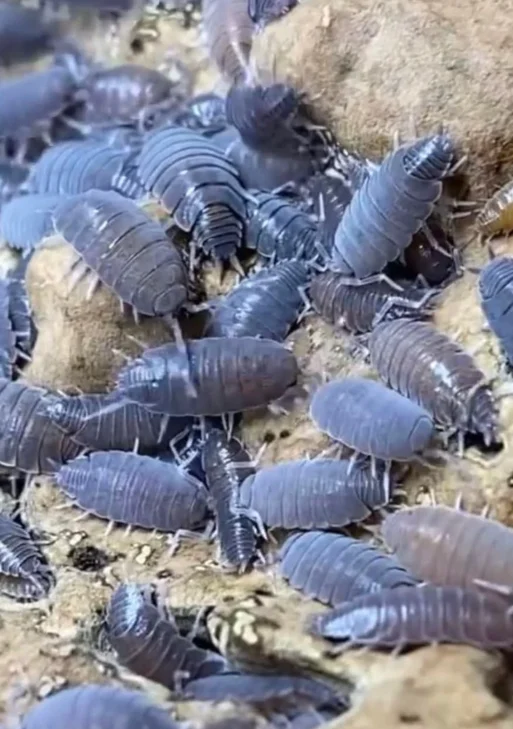
Isopods have become popular in India for bioactive terrariums, paludariums and as fascinating pets in their own right. Prices range widely, from affordable clean-up crews to collector species. This guide explains current isopod prices, why they differ, and which to start with.
Quick answer: In India, common bioactive clean-up crew isopods cost about ₹700 on Anubias.in, while the collector species Cubaris sp. “Rubber Ducky” costs about ₹1,200. Rare, slow-breeding species cost more because colonies grow slowly. Beginners should start with a hardy clean-up crew to learn humidity and feeding before buying expensive Cubaris.
Prices last checked against the Anubias.in store: 17 September 2026.
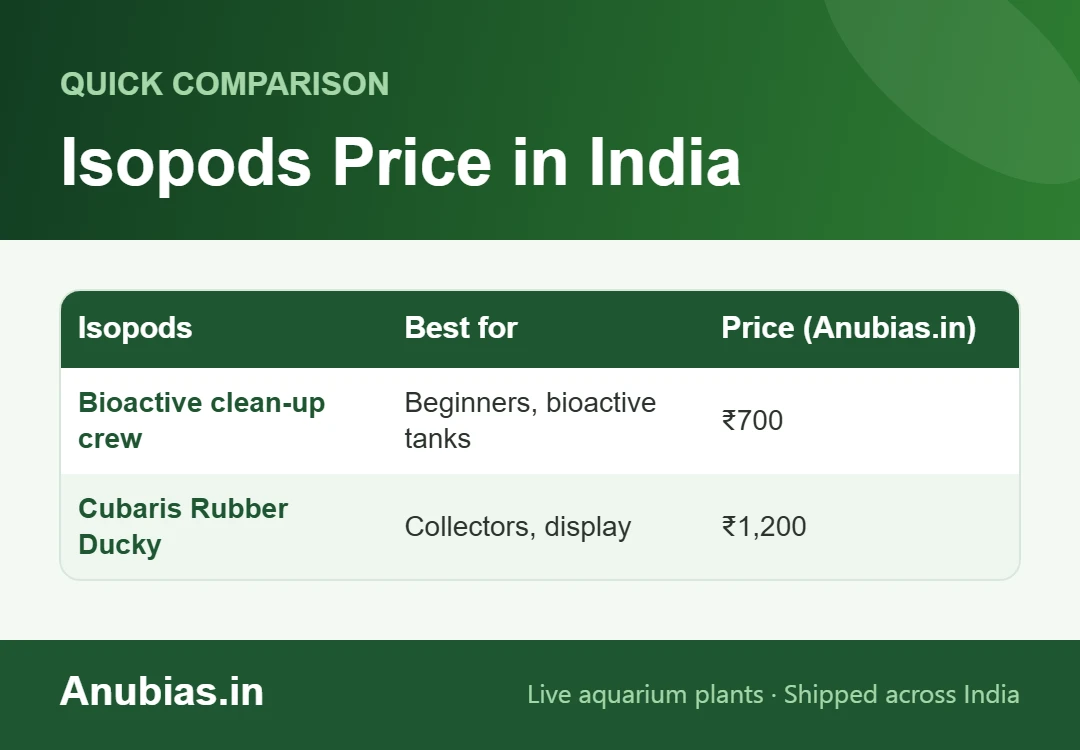
Isopod prices on Anubias.in
| Isopods | What you get | Best for | Price |
|---|---|---|---|
| Isopods (Bioactive Clean-Up Crew) | Hardy clean-up crew isopods | Bioactive terrariums, beginners | ₹700 |
| Cubaris sp. Rubber Ducky | Collector isopods | Display and breeding | ₹1,200 |
Why some isopods cost more
- Breeding speed: Rubber Ducky and other Cubaris produce few young and mature slowly.
- Demand: distinctive colours and faces are popular with collectors.
- Availability: limited captive-bred stock in India.
- Hardiness: common clean-up species breed fast and tolerate beginner mistakes.
Which isopods to buy first
- Start with a clean-up crew to learn humidity, ventilation and feeding.
- Once colonies are stable, move on to Cubaris species.
- Keep isopods on land: they are terrestrial and will drown underwater.
Care details: isopod clean-up crew guide and Rubber Ducky isopod care.
What you spend on besides the isopods
The animals are only part of the cost. A ventilated plastic tub, a layer of coco coir or leaf litter, a piece of cork bark or driftwood for hiding, and a source of calcium such as cuttlebone all add up, and none of it is optional if you want the culture to breed rather than just survive.
Most of these you can buy locally for very little, which is why a starter clean-up crew is cheap to keep going once it is set up. The expensive part is replacing a colony you lost, so it is worth having the enclosure running and moist for a few days before the isopods arrive.
Food is close to free. Vegetable scraps, dried leaves, a little fish flake for protein, and the odd piece of soft wood will keep a tub fed indefinitely. Overfeeding costs you more than underfeeding, because uneaten vegetables draw mites and mould.
Why new cultures fail in Indian homes
Heat is the first problem. A closed plastic tub sitting in a room at 34 degrees in May becomes a hot, wet box with no escape, and isopods will pile in a corner and die. Keep the tub in the coolest part of the house, away from windows, and give it a genuine cross-flow of air rather than a few pinholes.
The second is a substrate that is uniformly wet. Isopods need a gradient, damp at one end and barely moist at the other, so they can choose. Mist one side only and let the other stay dry.
The third is monsoon mould. High humidity plus leftover food equals a white bloom across the surface within days. Remove uneaten food every couple of days in the rainy months, and add springtails, which graze mould and coexist with isopods without competing for much.
The last is impatience. A small starter culture spends its first two months building numbers out of sight under the leaf litter. Digging through to count them repeatedly disturbs breeding females and slows everything down.
Plants in this guide
Grown in Surat · graded by leaf count and photographed before dispatch · live-arrival guarantee on every order · ₹99 shipping, free from ₹2,000
₹ 700 ₹ 1,000

Frequently asked questions
Why are Rubber Ducky isopods so expensive?
They breed slowly with small broods, so supply stays limited while demand is high.
Can isopods live in an aquarium?
No. They are land animals, but they can live on the land area of a humid paludarium.
What do isopods need to thrive in India?
High humidity with ventilation, temperatures around 22–28 °C, leaf litter, rotting wood and a calcium source such as cuttlebone.
Shop isopods on Anubias.in, shipped safely across India.
How many isopods should I start with?
Around ten to fifteen individuals is enough to found a stable culture of a common clean-up species, and more simply gets you to a harvestable colony sooner. For slower, pricier species a larger starting group is safer, because losing two or three animals matters much more. Always start with mixed sizes rather than all adults, since juveniles adapt to a new enclosure more readily.
How long before an isopod culture multiplies enough to use?
Common clean-up species usually take two to four months to visibly boom, and slower collector species can take twice that. Warmth speeds breeding, so a colony started before summer generally moves faster than one started in winter. Resist harvesting until you see juveniles of several different sizes, which means breeding has become continuous.
Do isopod enclosures smell?
A healthy enclosure smells like damp forest soil and nothing stronger. A sour or ammonia-like smell means either uneaten food rotting or a substrate that has gone waterlogged with no dry zone. Remove the food, add dry leaf litter, and improve the airflow, and the smell should clear within a few days.