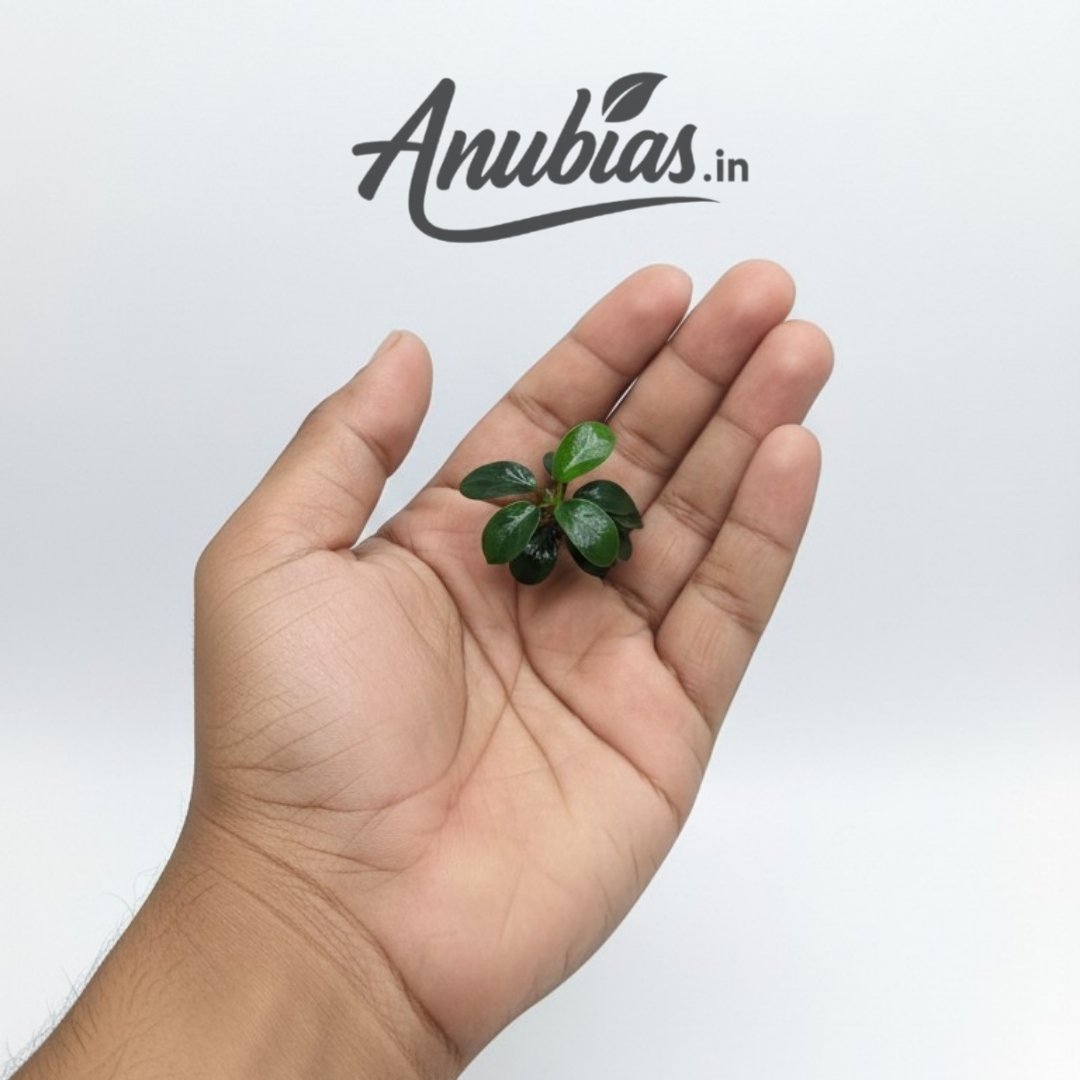


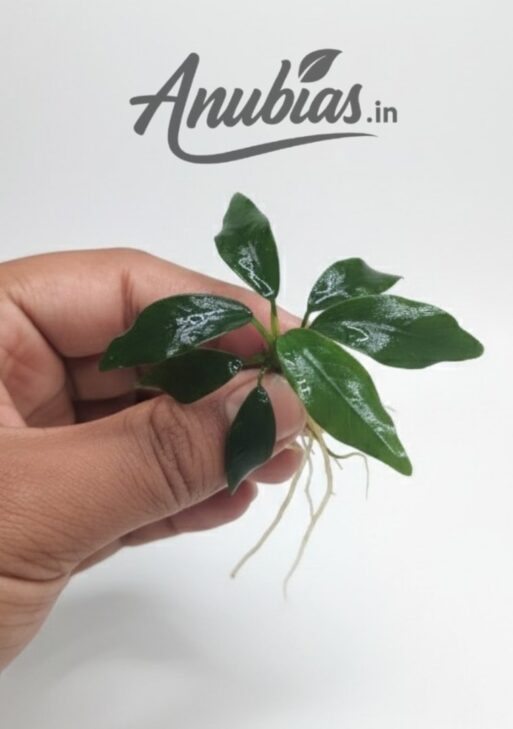
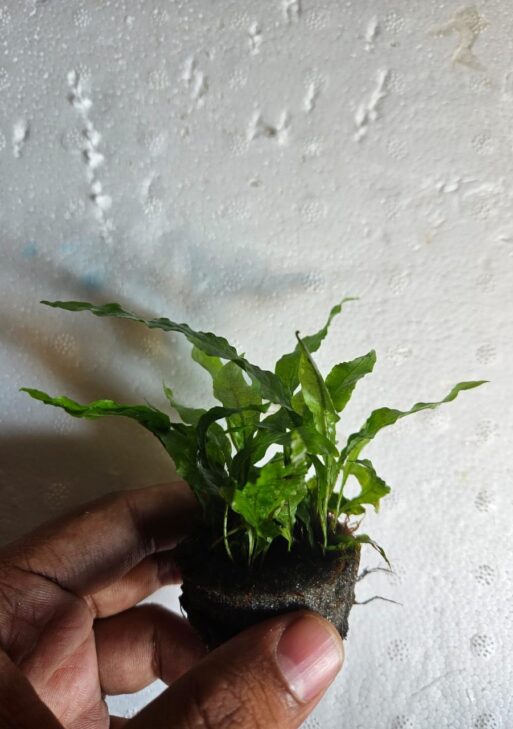
Anubias ‘Dragon Claw’ is a cultivar with twisted, curled leaves that arch like a dragon’s talons. It brings movement and texture to an aquascape while staying as tough as any classic Anubias.
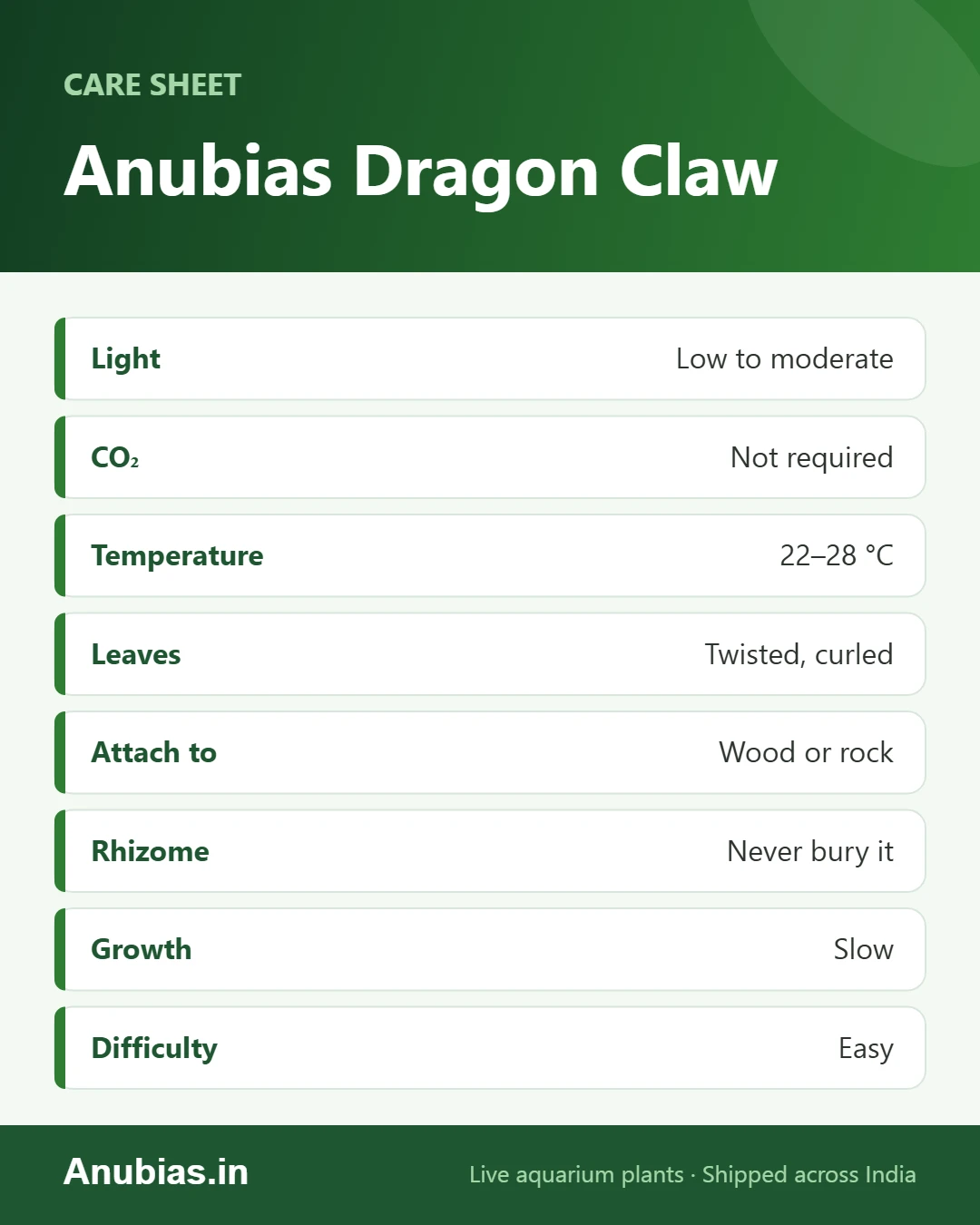
Quick answer: Anubias Dragon Claw is easy to grow: give it low to moderate light, no CO2 is required, and keep the water at 22–28°C. Tie or glue the rhizome to driftwood or rock and never bury it. Like all Anubias it grows slowly, so keep lighting moderate to avoid algae on its leaves. On Anubias.in it costs ₹90–₹250 depending on size.
Light, CO2 and water
Low to moderate light suits it best. CO2 is not needed; a light liquid fertiliser helps in tanks with few fish. Keep temperature between 22 and 28°C.
Placement and attaching
Its curled leaves look best at eye level on driftwood or rockwork in the midground, where the texture contrasts with flat-leaved plants such as Anubias Nana or Java fern. Attach with cotton thread or aquarium-safe gel glue. How to attach Anubias.
Growth and propagation
Growth is slow, typically one new leaf every few weeks in low-tech tanks. Once the rhizome is long, cut it into sections that each keep several leaves. How to propagate Anubias.
Tank mates for Anubias Dragon Claw
Anubias Dragon Claw is safe with bettas, gouramis, tetras, rasboras, danios, corydoras, livebearers, cherry and Amano shrimp and nerite snails, which leave its thick leaves alone; shrimp even clean the leaf surface. Large cichlids, silver dollars, crayfish and mature common plecos can shred or rasp it over time, and goldfish may nibble, so tie it firmly to hardscape. Anubias tank mates.
Common Anubias Dragon Claw problems
| Problem | Likely cause | Fix |
|---|---|---|
| Green or black spots on leaves | Algae from strong or long lighting | Cut light to 6–8 hours, shade the plant, wipe leaves |
| Soft, dark rhizome | Rhizome buried or damaged | Cut back to firm tissue and reattach to hardscape |
| Yellow new leaves | Low nutrients, often iron | Weekly complete liquid fertiliser |
| Pinholes in old leaves | Potassium shortage | Complete fertiliser with potassium |
| No new leaves for weeks | Normal slow growth or settling in | Be patient; about one leaf every 2–3 weeks is normal |
Its curled, twisted leaves are natural for this cultivar and not a sign of stress. Anubias leaf problems · Anubias not growing.
Is Dragon Claw worth it over a standard Anubias?
Dragon Claw costs more than common Anubias varieties and grows no faster, so the honest answer depends on what you want from the plant.
Worth it if: you already keep flat-leaved Anubias and the tank looks a little uniform, you want a single focal plant rather than mass planting, or you enjoy plants with unusual leaf shape at close viewing distance.
Not worth it if: you need to fill a large background, you are still learning the basics of rhizome plants, or you want visible progress in the first few months. In all three cases a common Anubias gives you far more plant for the money.
A sensible middle path is one Dragon Claw as a specimen piece surrounded by cheaper Anubias. The contrast makes both look better, and you are not risking much on a single plant while you learn how it behaves in your water.
Aquascaping with Dragon Claw
The twisted, deeply textured leaves need space and contrast to read properly. A few placement rules make the difference.
- Give it a clear background. Against a busy stem thicket the leaf shape disappears. Against bare wood, dark rock or open water, it stands out.
- Place it side-on to the viewer. Viewed from directly above, the curled leaves flatten visually. Attached to a vertical wood face at eye level they catch the light.
- Pair it with something smooth. Flat-leaved Anubias, Java fern or a patch of moss below it emphasises the texture by comparison.
- Leave room around it. Crowding a textured plant is the usual mistake. A gap of a few centimetres on each side lets the silhouette show.
- Keep it in gentle flow. The folds trap debris, and moving water keeps the leaves cleaner with no effort from you.
Through Indian summers, expect this plant to hold rather than grow. That is normal for Anubias at 30°C and above, and it recovers once the water cools.
Plants in this guide
Grown in Surat · graded by leaf count and photographed before dispatch · live-arrival guarantee on every order · ₹99 shipping, free from ₹2,000
Price range: ₹ 90 through ₹ 250
Price range: ₹ 90 through ₹ 250
Price range: ₹ 90 through ₹ 250
Price range: ₹ 90 through ₹ 250
Frequently asked questions
Is Anubias Dragon Claw easy to grow?
Yes. It needs low to moderate light, no CO2 and simple attachment to wood or rock.
Why are Dragon Claw leaves curled?
The twisted, curled leaves are the natural look of this cultivar, not a sign of a problem.
How much does Anubias Dragon Claw cost in India?
Anubias Dragon Claw on Anubias.in costs ₹90–₹250 depending on size.
Planning a nano tank? See the Anubias Chili care guide.
Does Dragon Claw need different care from Anubias Nana?
No, the care is essentially identical: low to moderate light, no CO2 needed, and the rhizome kept above the substrate. The only practical difference is that the textured leaves collect more debris, so a spot with gentle water movement is worth choosing. Treat it as a standard Anubias in every other respect.
Can I keep Dragon Claw in a shrimp-only nano tank?
Yes, and shrimp tanks suit it well since there are no fish to dig or nibble at it. Shrimp will graze biofilm from the folded leaves, which actually helps keep them clean. Just make sure the tank is big enough that a mature Dragon Claw does not dominate the whole layout.
How do I stop debris collecting in the leaves?
Position it where there is light, steady flow rather than in a dead corner, which prevents most build-up on its own. For anything that settles anyway, a gentle wave of a turkey baster or a soft brush during your water change clears it. Avoid scrubbing, since the leaf surface damages more easily than a flat Anubias leaf.



![Green Plus + Trace Fertilizer [ 250ML + 250ML ]](https://anubias.in/wp-content/uploads/2026/04/1000647632.jpg)