
Aquarium fertilisers come in two main forms: liquids you dose into the water and root tabs you push into the substrate. Using the wrong one is a common reason plants stay pale or grow slowly. Here is how each works and which your plants actually need.
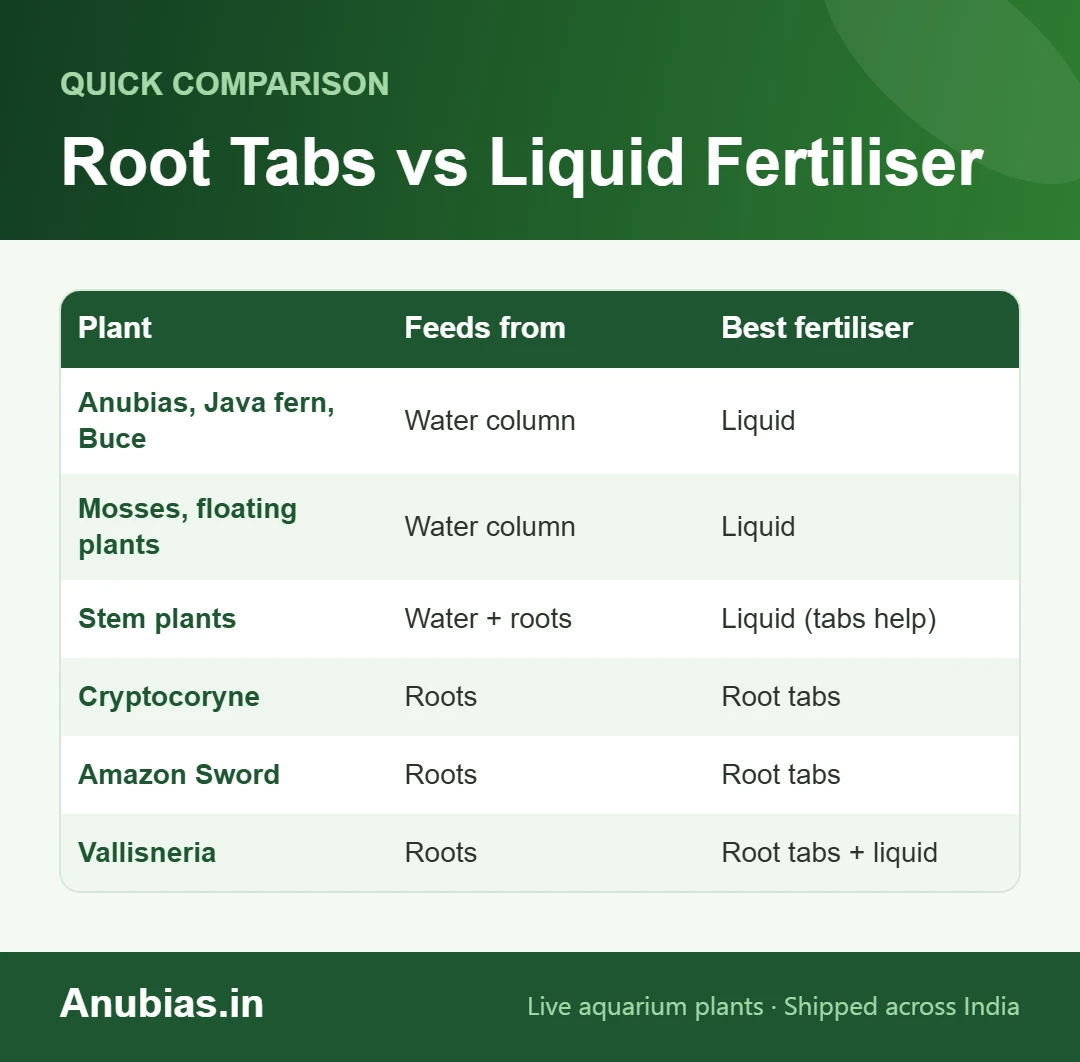
Quick answer: Plants that take nutrients from the water, such as Anubias, Java fern, Bucephalandra, mosses and floating plants, need liquid fertiliser. Heavy root feeders such as Cryptocoryne, Amazon swords and Vallisneria grow best with root tabs pushed into the substrate near their roots, especially in plain gravel. Most mixed planted tanks benefit from a weekly complete liquid fertiliser plus root tabs every few months for rooted plants.
How liquid fertiliser works
Liquid fertiliser feeds plants through the water column. Nutrients reach leaves, rhizomes and hanging roots directly, which is exactly how epiphytes and floaters feed. A two-part system like Green Plus + Trace supplies macronutrients (nitrogen, phosphorus, potassium) in one bottle and iron and trace elements in the other. Dose after your weekly water change following the bottle directions.
How root tabs work
Root tabs release nutrients slowly into the substrate. Rooted plants draw them up through their roots, which is how Cryptocoryne and swords feed in nature. They matter most in inert gravel or sand, which contains almost no nutrients. Push a tab deep near the roots and replace it every couple of months, following the product directions.
Which do you need?
- Only epiphytes and floaters: liquid fertiliser only.
- Crypts, swords, Vallisneria in plain gravel: root tabs, plus liquid for overall health.
- Nutrient-rich aqua soil: liquid first; root tabs once the soil is exhausted after many months.
- Mixed tank: both.
Placing root tabs the right way
Most complaints about root tabs come from how they were inserted rather than the product itself. A tab sitting half exposed dissolves into the water column, which is the one thing it was not meant to do.
- Work out where the roots actually are. Aim two to three centimetres out from the crown of the plant, not directly underneath it.
- Make a hole with long tweezers or a chopstick first, then drop the tab in. Pushing a tab down with your fingers usually leaves a trail of nutrient in the water.
- Bury it properly, at least three to four centimetres deep, and cap the hole by pressing the substrate closed over it.
- Do it right before a water change, not after, so anything that escapes gets siphoned out.
- Space tabs across the planted area rather than clustering them, and keep them out of any open sand you plan to vacuum.
- Note the date. Tabs are exhausted long before you notice, and guessing leads to double dosing.
In a shallow substrate of two centimetres or less, tabs are hard to bury properly. Either deepen the substrate locally around heavy root feeders or accept that a liquid-led approach suits that tank better.
Reading the tank before you change anything
Before buying either product, spend a week looking at which plants are struggling. The pattern tells you which route to take.
- Rooted plants such as crypts and swords fading while your attached Anubias and moss look fine: the substrate is the problem, so add tabs.
- Epiphytes and floating plants stalling while rooted plants thrive: the water column is short, so start or increase liquid dosing.
- Everything pale at once, including new growth: this is more often light or carbon dioxide than fertiliser.
- Older leaves yellowing while new leaves look fine: the plant is moving nutrients internally, a classic sign of an underfed root zone.
- Pinholes appearing in otherwise green leaves: usually potassium, which comes from liquid rather than tabs.
- Good plant growth with rising algae: back off the light before you back off the fertiliser.
Change one thing, then wait three to four weeks. Slow-growing plants cannot show you a result faster than that, and stacking changes leaves you with no idea what worked.
Plants in this guide
Grown in Surat · graded by leaf count and photographed before dispatch · live-arrival guarantee on every order · ₹99 shipping, free from ₹2,000
![Green Plus + Trace Fertilizer [ 100ML + 100ML ]](https://anubias.in/wp-content/uploads/2026/04/1000647632-513x654.jpg)
![Green Plus + Trace Fertilizer [ 100ML + 100ML ]](https://anubias.in/wp-content/uploads/2026/04/1000647617-513x729.jpg)
₹ 250 ₹ 410
₹ 410 ₹ 580
Frequently asked questions
Can I use only liquid fertiliser for Cryptocoryne?
They survive, but crypts and swords usually grow better with root tabs because they feed mainly through their roots.
Do root tabs cause algae?
Buried properly, they release nutrients into the substrate rather than the water, so algae risk is low. Avoid leaving tabs exposed on the surface.
How often should I dose liquid fertiliser?
Can I make root tabs from garden or houseplant fertiliser?
It is not worth the risk in a tank with fish. Garden fertilisers are often urea or ammonium based and can release ammonia into the water, and the copper levels in some are harmful to shrimp. Purpose-made aquarium tabs release slowly and are formulated without those hazards.
Do I stop liquid dosing once I have added root tabs?
No, keep dosing liquid as normal. Root tabs feed the plants that take nutrients through their roots, and do almost nothing for Anubias, Java fern, moss and floating plants. The two are complementary rather than alternatives, which is why most mixed tanks run both.
Should I dose fertiliser in a brand new tank that is still cycling?
Dose lightly or not at all for the first two weeks. A new tank has few plants using nutrients and plenty already present from the substrate and tap water, so adding more mostly feeds algae. Start at a reduced dose once plants are visibly pushing new growth.
Mixing your own ferts? See DIY dry fertiliser dosing in India for salts, sources and safe doses.


![Green Plus + Trace Fertilizer [ 250ML + 250ML ]](https://anubias.in/wp-content/uploads/2026/04/1000647632.jpg)