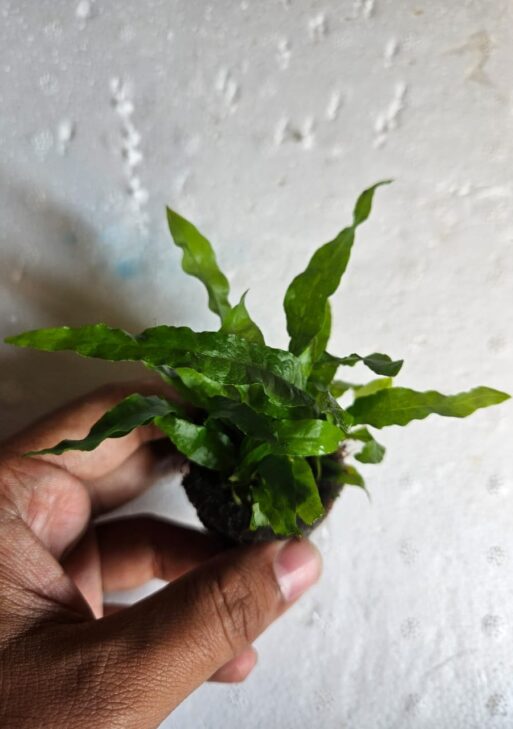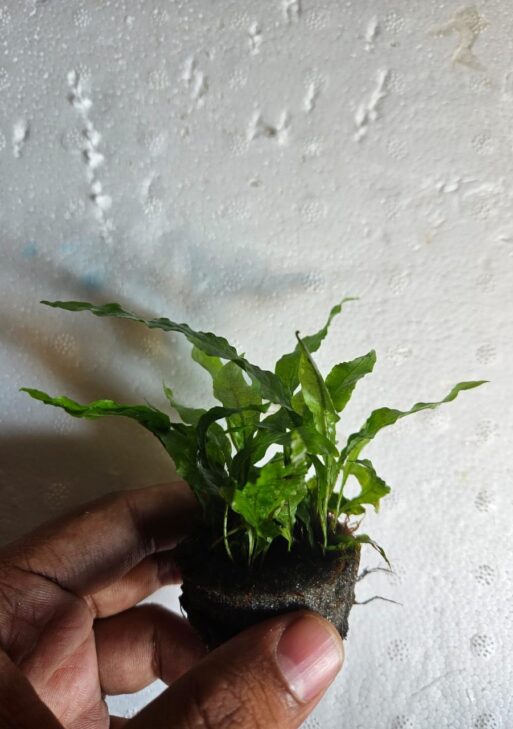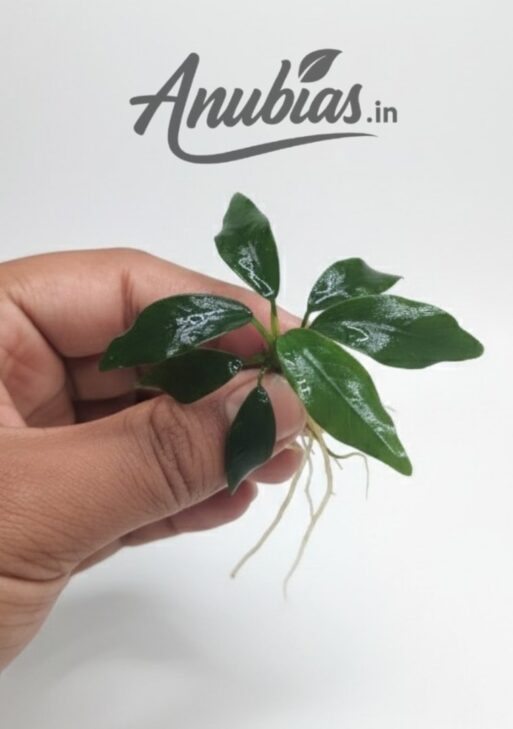

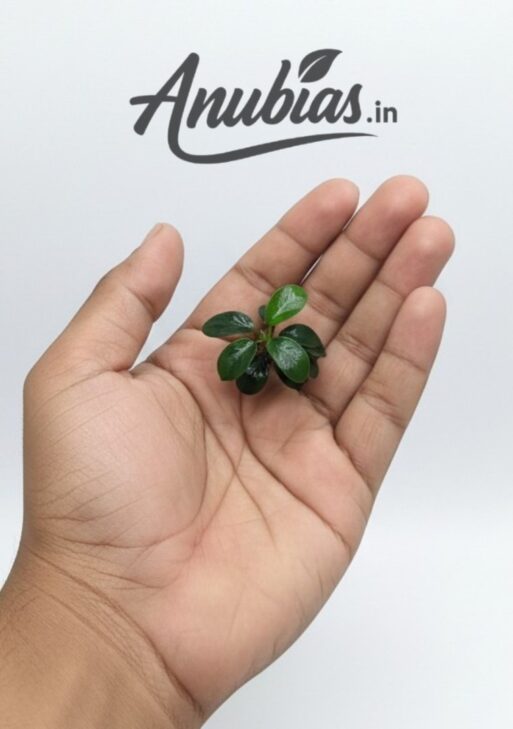
Anubias congensis is a larger, robust Anubias with narrow, lance-shaped leaves. It brings height to the midground or background while keeping the toughness Anubias are known for.
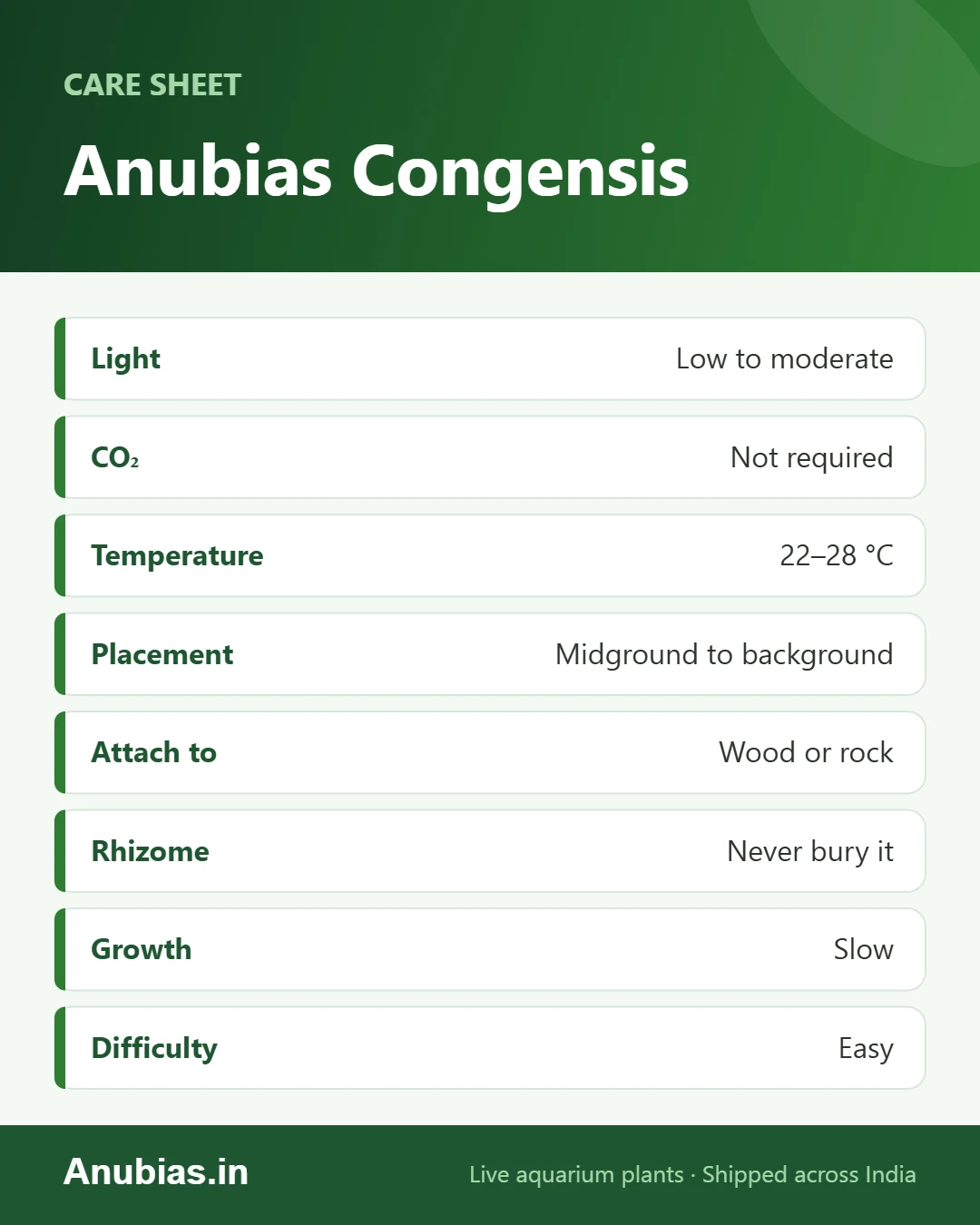
Quick answer: Anubias congensis is an easy plant: give it low to moderate light, no CO2 is required, and keep the water at 22–28°C. Attach the rhizome to driftwood or rock and never bury it. Because it is larger than Anubias nana, place it in the midground or background, where its narrow leaves add height. Growth is slow, so avoid long, intense lighting that encourages algae on the leaves.
Light, CO2 and water
Low to moderate light is ideal. CO2 is not required, and a light weekly liquid fertiliser helps in tanks without many fish. Keep temperature in the 22–28°C range.
Placement and attaching
Tie or glue the rhizome to driftwood or rock with cotton thread or aquarium-safe gel glue. The roots grip within a few weeks. Its size suits the midground to background of medium and larger tanks, and it pairs well with smaller Anubias nana in front.
Tank mates for Anubias Congensis
Anubias Congensis is safe with bettas, gouramis, tetras, rasboras, danios, corydoras, livebearers, cherry and Amano shrimp and nerite snails, which leave its thick leaves alone; shrimp even clean the leaf surface. Large cichlids, silver dollars, crayfish and mature common plecos can shred or rasp it over time, and goldfish may nibble, so tie it firmly to hardscape. Anubias tank mates.
How to propagate Anubias Congensis
Once the rhizome is long enough, cut it with a clean blade so each piece keeps several leaves, then tie or glue each section to wood or rock. New growth appears from the cut ends over the following weeks. How to propagate Anubias.
Common Anubias Congensis problems
| Problem | Likely cause | Fix |
|---|---|---|
| Green or black spots on leaves | Algae from strong or long lighting | Cut light to 6–8 hours, shade the plant, wipe leaves |
| Soft, dark rhizome | Rhizome buried or damaged | Cut back to firm tissue and reattach to hardscape |
| Yellow new leaves | Low nutrients, often iron | Weekly complete liquid fertiliser |
| Pinholes in old leaves | Potassium shortage | Complete fertiliser with potassium |
| No new leaves for weeks | Normal slow growth or settling in | Be patient; about one leaf every 2–3 weeks is normal |
Because it is a larger Anubias, give it space so neighbouring plants do not shade its lower leaves. Anubias leaf problems · Anubias not growing.
Anubias congensis or Anubias barteri: which suits your tank
These two are the usual choice for anyone wanting a larger Anubias, and they behave quite differently in a layout.
Anubias congensis has narrow, lance-shaped leaves held fairly upright on shortish stems. The overall shape is vertical and slim, so it reads as texture rather than bulk. That makes it useful behind rock or wood where you want height without blocking the view.
Anubias barteri carries broad, rounded leaves on longer petioles and spreads outwards. It fills space quickly and works as a screen, but a single plant can take over a 2-feet tank.
As a rule, choose congensis for narrow tanks, for layouts with a lot of hardscape, or when you want an Anubias that does not smother its neighbours. Choose barteri when you need to cover a filter intake or a bare stretch of back glass. Broad barteri leaves also collect more algae, simply because there is more flat surface sitting still under the light.
What the first month looks like
Newly bought Anubias congensis is usually grown emersed at the nursery, so its existing leaves were formed in air. Expect a settling-in period rather than immediate growth.
- Week one. Attach the rhizome and leave it alone. Some older leaves may yellow or develop soft patches; trim those at the base.
- Week two. Roots begin to grip. Do not lift the plant to check, as that breaks the new attachment.
- Weeks three and four. A new leaf appears, often smaller and a paler green than the old ones. This is the first submerged growth and the real sign the plant has accepted the tank.
Through Indian summers above 30°C, congensis often pauses entirely rather than melting. Keep flow moving over the leaves, avoid raising light to force growth, and it will pick up again when the water cools.
Plants in this guide
Price range: ₹ 90 through ₹ 250
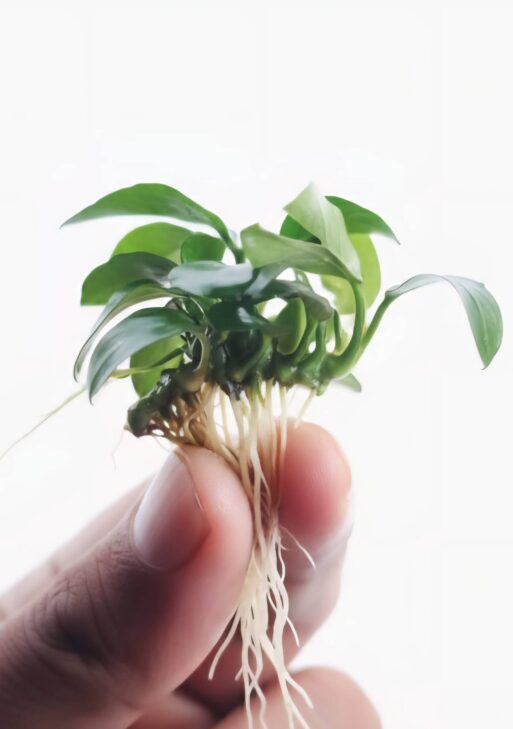
Price range: ₹ 90 through ₹ 250
Price range: ₹ 90 through ₹ 250
₹ 200
Frequently asked questions
Is Anubias congensis easy to grow?
Yes. It is a hardy, slow-growing Anubias that does well in low light without CO2.
Is Anubias congensis safe for shrimp?
Yes, it is safe for shrimp tanks and community aquariums.
Where can I buy Anubias congensis in India?
Anubias congensis is available on Anubias.in on pre-order, typically arriving in about 15 days.
Filling a big tank? Compare the best large Anubias varieties.
How tall does Anubias congensis actually get?
In most home aquariums it settles at roughly 20 to 30 cm, though it takes a long time to reach that because growth is so slow. Height depends mainly on how much space the rhizome has and how strong the light is above it. Plants attached high on wood look taller simply because they start from a higher point.
Can I grow Anubias congensis in a sand-only tank?
Yes, because it does not feed from the substrate at all. Attach the rhizome to a rock or piece of wood sitting on the sand and it will take nutrients from the water column. Weekly liquid fertiliser matters more in this setup than any substrate choice.
Should I trim old Anubias congensis leaves?
Trim any leaf that is heavily covered in algae, damaged or yellowing, cutting the stalk close to the rhizome with clean scissors. Removing tired leaves pushes the plant to put energy into new growth and improves the look immediately. Healthy old leaves are worth keeping, since a slow grower cannot replace them quickly.