

Red Myrio (Myriophyllum tuberculatum) has soft, feathery leaves in orange to deep red, and a group of it creates one of the most eye-catching focal points in a planted tank. It is more demanding than green stem plants, so this guide explains what it needs to stay red and healthy.
Quick answer: Red Myrio is a medium-difficulty stem plant that needs strong light, regular fertiliser with iron and ideally CO2 to stay red and bushy. Keep water at 22–28 °C, plant stems 2–3 cm apart in the background, trim and replant tops regularly, and avoid algae-eating fish that nibble its soft leaves. In low light without CO2 it turns green, grows thin and may melt.
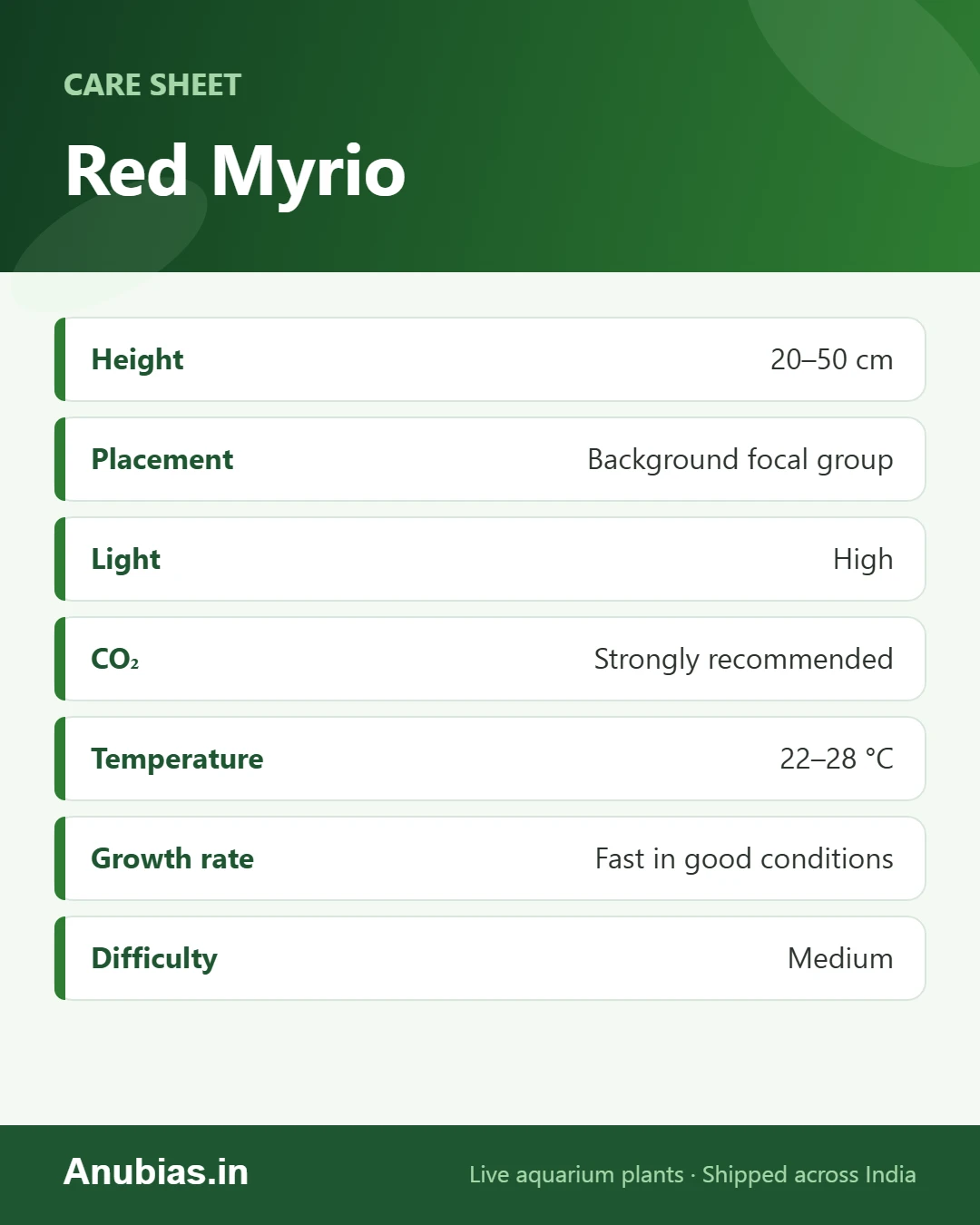
Red Myrio care sheet
| Parameter | Recommendation |
|---|---|
| Scientific name | Myriophyllum tuberculatum |
| Origin | South and Southeast Asia, including India |
| Height | 20–50 cm |
| Placement | Background focal group |
| Light | High |
| CO₂ | Strongly recommended |
| Temperature | 22–28 °C |
| Growth rate | Fast in good conditions |
| Difficulty | Medium |
| Price in India | From ₹70 on Anubias.in |
How to keep Red Myrio red
- Strong light: the most important factor; use a planted-tank LED and do not shade it with floaters.
- Iron and micronutrients: dose a complete liquid fertiliser; pale or yellow tips signal a shortage.
- CO2: keeps stems thick and leaves dense and colourful.
- Stable nitrate at moderate levels: very high nitrate keeps it greener; very low nitrate stunts it.
Planting and trimming
- Remove weights and plant stems individually, 3–4 cm deep and 2–3 cm apart.
- Give it a clear spot directly under the light.
- Trim when stems approach the surface and replant the healthiest tops.
- Remove leggy bottoms periodically and replace them with fresh tops.
Why is my Red Myrio melting or turning green?
- Melting after planting: adjusting to new water or emersed-to-submerged change; keep conditions stable.
- Green, thin growth: not enough light.
- Leaves covered in debris or algae: fine leaves trap dirt; improve flow and clean gently.
- Stunted, twisted tips: nutrient shortage; check fertiliser dosing.
More stem plant guides:
Where to place Red Myrio
Plant Red Myrio in groups of several stems towards the back or sides of the tank, where it can grow up without shading slower foreground plants. Leave a little space between stems so light reaches the lower leaves. Best background plants
Common Red Myrio problems
| Problem | Likely cause | Fix |
|---|---|---|
| Tall, thin stems with big gaps between leaves | Too little light | Increase light intensity gradually, keep 6–8 hours a day |
| Lower leaves dropping | Shading from the top of the group or low light | Trim and replant tops; thin crowded stems |
| Pale or yellow new leaves | Iron or trace nutrient shortage | Weekly complete fertiliser with iron |
| Leaves melting after planting | Adjusting to new water | Remove damaged leaves; new growth follows |
| Stays green instead of red | Not enough light or iron | Stronger light, iron-rich fertiliser, avoid very high nitrate |
Why plants are not turning red · Yellow leaves: causes and fixes
Plants in this guide

Frequently asked questions
Can Red Myrio grow without CO2?
It can survive with strong light and good fertiliser, but growth is slower, thinner and less red. For low-tech tanks, Ludwigia Repens is an easier red plant.
Is Red Myrio safe for shrimp?
Yes. Its fine leaves are good grazing and hiding spots for shrimp.
Why is Red Myrio so cheap if it is demanding?
It grows fast in nursery conditions and is propagated easily from cuttings, so it is affordable; the challenge is keeping it red in a home tank.
Buy Red Myrio or browse our stem plants, shipped across India with a live-arrival guarantee.
Red plants staying green? See how to get red colour in Ludwigia and Red Myrio.