

Quick answer: Most planted tanks need roughly four to seven plants per foot of tank length, spread across background, midground and foreground. In practice that is about 5 to 7 plants for a 1 ft nano, 8 to 12 for a standard 2 ft tank, and 14 to 20 for a 3 ft. Carpets are counted separately, at three to four pots per square foot of substrate.
Count the area you want covered, not the pots in your basket
Almost everyone buying plants for the first time counts pots. Six pots sounds like a lot until they are in the tank, spread across two feet of glass, each the size of a matchbox.
The useful question is how much of the tank you want to look planted. A pot of Monte Carlo covers a few square centimetres on day one. A single Anubias covers about a palm of driftwood once it has grown in.
So work zone by zone. Decide what fraction of the substrate, hardscape, back wall and surface should be green, then buy enough to reach that in a reasonable time.
Tank size to plant count: the quick table
These are total plant counts across all layers, not including a carpet, which is priced and counted separately below. Litres are the full glass volume; actual water is roughly 10 to 15 per cent less once substrate and hardscape go in.
| Tank size | Typical dimensions | Approx. litres | Plants per layer | Approx. plant cost |
|---|---|---|---|---|
| 1 ft nano | 30 x 30 x 30 cm | 27 L | 1-2 background, 2-3 epiphytes, 1 floater portion | ₹450 – ₹800 |
| 1.5 ft | 45 x 30 x 30 cm | 40 L | 2 background, 3-4 midground, 2 foreground | ₹700 – ₹1,100 |
| 2 ft | 60 x 30 x 30 cm | 54 L | 2-3 background, 3-4 midground, 2-3 foreground plus floaters | ₹900 – ₹1,200 |
| 3 ft | 90 x 45 x 45 cm | 182 L | 5-7 background, 5-8 midground, 4-5 foreground | ₹1,800 – ₹2,600 |
| 4 ft | 120 x 45 x 45 cm | 243 L | 7-10 background, 7-10 midground, 5-8 foreground | ₹2,400 – ₹3,500 |
If you think in gallons, a 20 gallon planted tank is about 76 litres, which sits between our 2 ft and 3 ft rows. Around 12 to 16 plants gets it looking planted rather than decorated.
Note where these totals land against shipping. Orders below ₹2,000 carry a ₹99 shipping charge and orders above it ship free, so a 3 ft or 4 ft plant list usually crosses the free threshold on its own.
Foreground and carpets: pots per square foot
Carpeting plants are the one place where pot counting fails badly. A carpet is a surface you are filling, so measure the footprint in square feet and buy per square foot.
Plan on three to four pots per square foot if you want the carpet to close in roughly two months. Two pots per square foot works if you are patient and will wait three to four months with visible gaps in between.
This is why three pots never carpets a 2 ft tank. The footprint of a 60 x 30 cm tank is about two square feet, so three pots is well under half of what a quick carpet needs, even before you subtract the area taken by rocks and wood.
The technique matters as much as the quantity. Split each pot into small portions of five or six strands and plant them 3 to 4 cm apart in a grid. Planting the pot as one clump gives you one clump, not a carpet.
Monte Carlo and dwarf hairgrass are ₹150 a pot, Staurogyne repens is ₹180, and dwarf sagittaria is ₹140. A two square foot carpet therefore runs roughly ₹900 to ₹1,200 on top of the table above.
Midground and epiphytes: how many per piece of wood
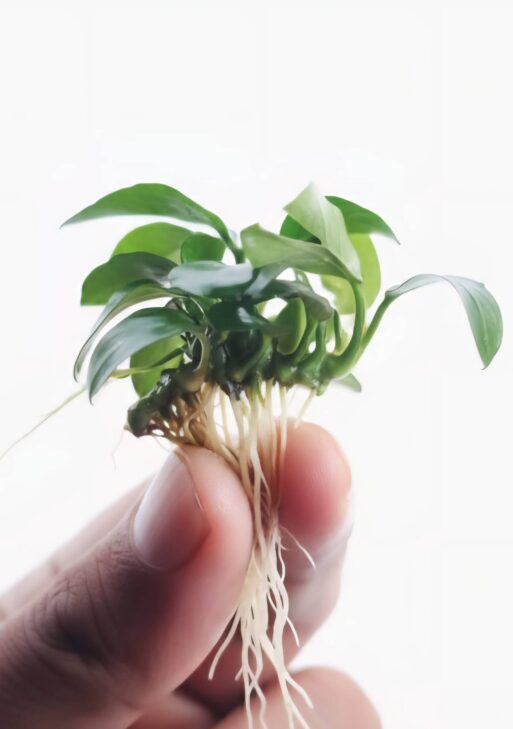
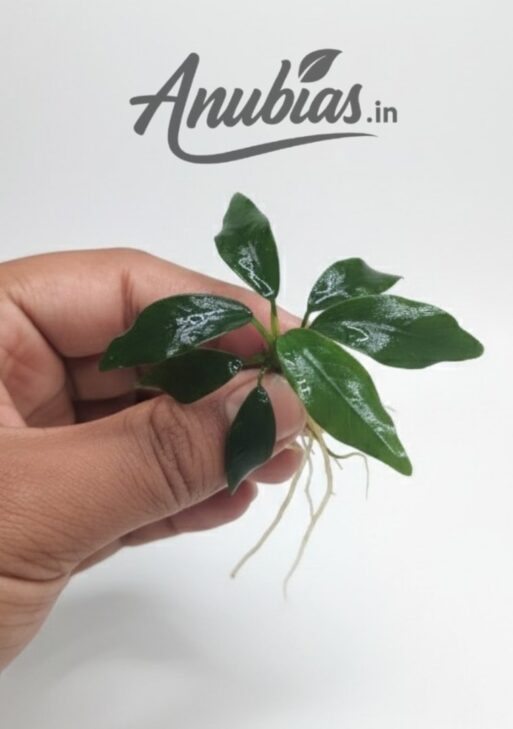
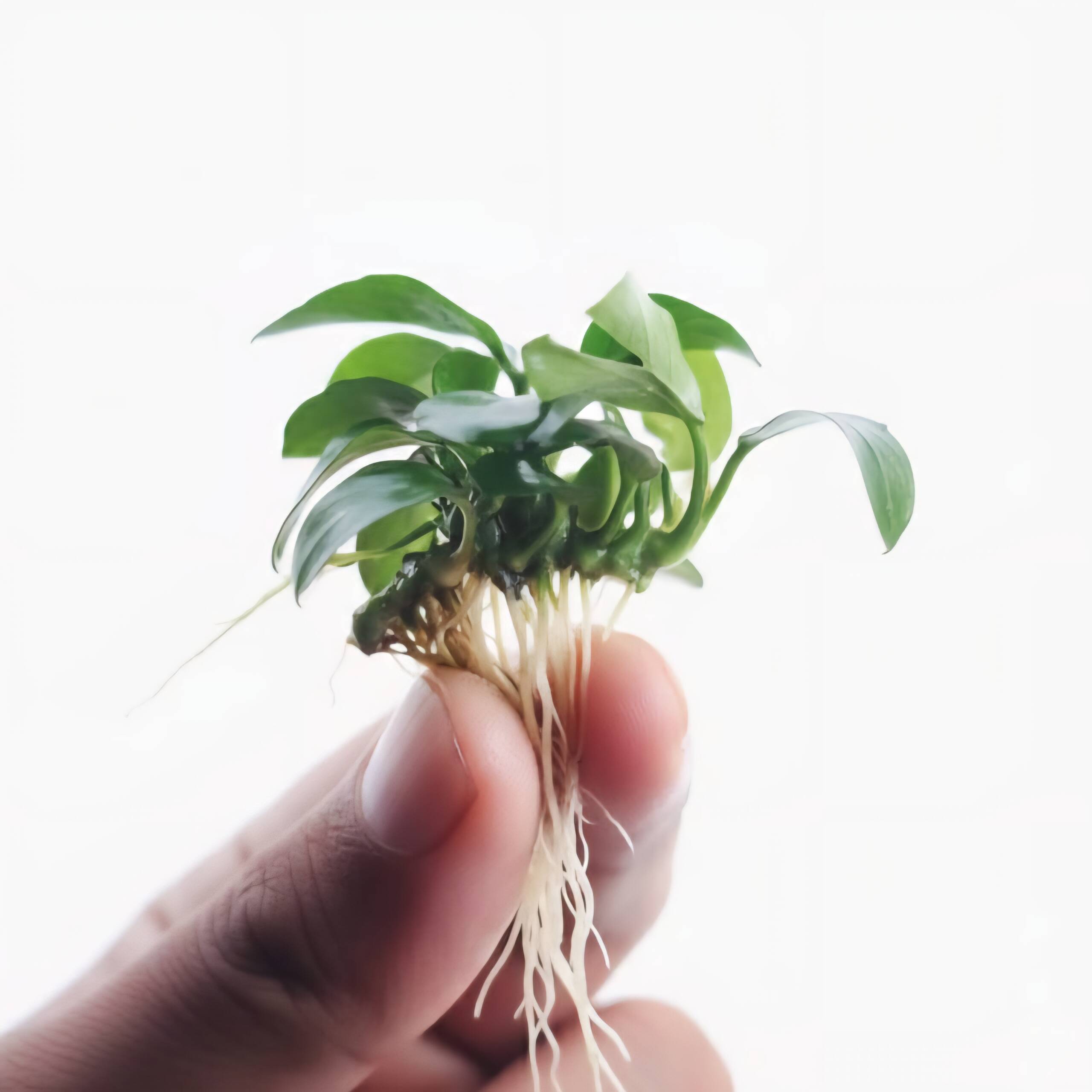
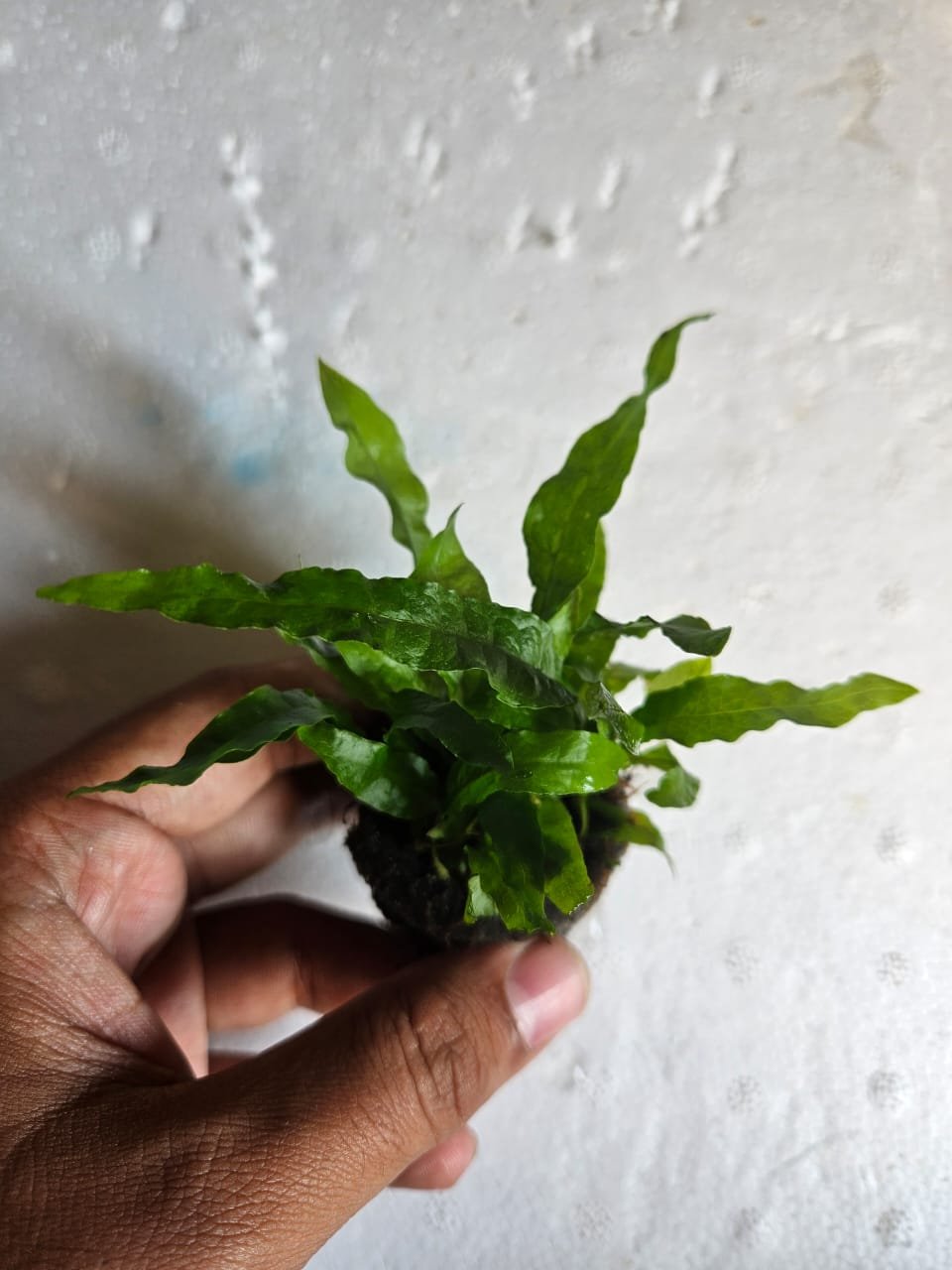
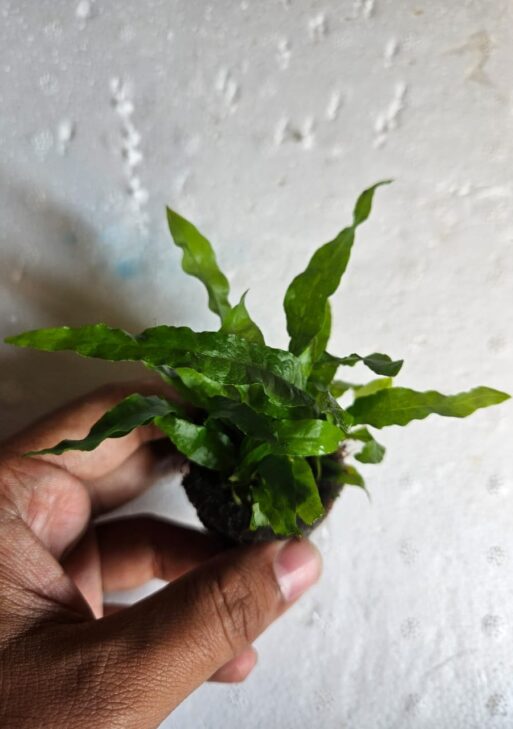
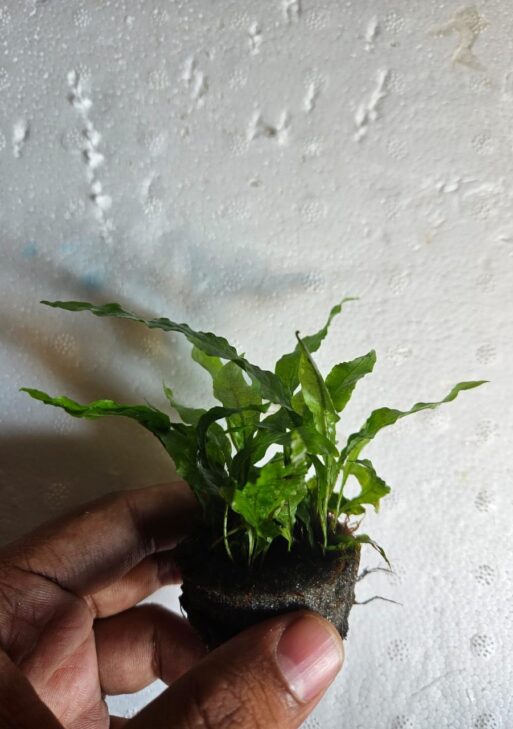
Anubias, Bucephalandra and Java fern are not planted in substrate at all. They attach to wood and rock, and their rhizome, the thick horizontal stem the leaves grow from, must never be buried or it rots.
Count these by hardscape, not by litres. A 20 to 25 cm piece of driftwood comfortably takes two or three pieces: one larger Anubias at the base and one or two smaller plants further up a branch.
Bucephalandra stays small, so it reads better in groups of three attached close together than as single pieces spread around. Three of one variety looks deliberate; one each of three varieties looks like a collection.
Java fern goes the other way. It gets large, so one plant per medium piece of wood is usually enough, and two on a big branch is plenty for a 3 ft tank.
Budget-wise, standard Anubias such as Nana, Nana Petite, Nana Gold, Barteri glabra and Dragon Claw are ₹90 each, Java fern is ₹175, and Bucephalandra starts at ₹299 for Wavy Green and ₹399 for Kedagang. A 2 ft tank with three wood pieces might take four Anubias and one Java fern, or about ₹535.
Background stems: bunches, spacing and the month-two look
Stems are sold as bunches, and a bunch is a small handful, enough to fill a patch about the width of your palm. One bunch does not make a background.
For a solid back wall, plan two to three bunches per 30 cm of tank length. That is roughly four to six bunches across a 2 ft tank and six to nine across a 3 ft.
Separate the bunch before planting and push each stem in individually, about 2 cm apart. Stems planted as a tied bundle rot at the base where water cannot circulate, which is the single most common reason a new background thins out.
Here is the honest part about month two. Stems grow fast, so a thin planting does fill in, but it fills in as a few tall spindly stalks with bare lower halves rather than a dense hedge. Dense from the start, then trimmed, is what produces bushy growth, because every trim makes each stem branch.
Rotala rotundifolia, Bacopa caroliniana and water wisteria are ₹120 a bunch, Ludwigia repens is ₹140, and Cabomba and red myrio are ₹70. A properly dense 2 ft background is roughly ₹400 to ₹600.
Floaters: how much surface to cover
Floaters are the easiest layer to get wrong because they multiply. Start with one portion regardless of tank size and let it spread.
Aim for 20 to 30 per cent surface cover. That is enough to soften the light, soak up excess nutrients and give surface-dwelling fish some shade.
Past about half the surface you are taking light away from everything below, and carpets are the first casualty. If your Monte Carlo starts reaching upwards instead of spreading sideways, thin the floaters before you touch anything else.
Amazon frogbit, water lettuce and water hyacinth are ₹90 and duckweed is ₹60. Skim a handful out every week or two and the layer stays put.
Heavy from day one, or fill in later?
Plant heavily at setup if you can afford it. A new tank has nutrients in the water column and nothing competing for them, and whatever does not get used by plants gets used by algae.
Algae is not a punishment for doing something wrong. It grows where there is light and food that plants are not taking, and a densely planted tank takes that food first.
Filling in later works, but it costs more overall because you generally place two orders, and you spend the first couple of months managing algae on bare substrate and glass.
If the budget only stretches so far, load up on fast growers. Stems, water wisteria, Egeria densa at ₹60 and floaters are cheap per unit of growth, and they do the nutrient work while your slower Anubias and crypts settle in.
Whatever you plant, keep the lights on 6 to 8 hours a day on a timer. Longer photoperiods do not speed plants up; they mostly feed algae.
Three worked examples
1 ft nano, roughly 27 litres
One piece of wood with two Anubias Nana Petite at ₹90 each, a portion of Java moss at ₹120, one pot of Monte Carlo at ₹150 split across the front third, and a small portion of frogbit at ₹90. Five items, about ₹540, and the tank looks furnished rather than decorated.
Skip the background layer entirely at this size. A 30 cm tank does not have the depth for stems without looking crowded.
2 ft low-tech, roughly 54 litres
Three Anubias at ₹90 and one Java fern at ₹175 on the wood, two Cryptocoryne wendtii at ₹150 in the midground substrate, four bunches of Rotala rotundifolia and water wisteria at ₹120 each, and one portion of Amazon frogbit at ₹90. That is about ₹1,305 and around twelve plants.
No carpet in this one. Low-tech tanks without CO2 carpet slowly, so dwarf sagittaria or a wide midground of crypts is the less frustrating route.
3 ft community, roughly 182 litres
Six bunches of mixed stems at roughly ₹120, six Anubias and Bucephalandra across two or three wood pieces, two Amazon swords at ₹180 as corner anchors, three Cryptocoryne in the midground, and a floater portion. Call it ₹2,400 to ₹2,800 without a carpet.
Add roughly four square feet of carpet at three pots per square foot and that is another ₹1,800, worth planning as a separate month-two order if the first bill is already large.
Plants in this guide
Grown in Surat · graded by leaf count and photographed before dispatch · live-arrival guarantee on every order · ₹99 shipping, free from ₹2,000


Want a ready-made set? See our aquarium plant starter kits for nano, betta, 2 ft and 3 ft tanks.
Frequently asked questions
How many plants do I need for a 2 feet fish tank?
Plan on 8 to 12 plants for a 2 ft tank that looks properly planted, or 5 to 6 for a deliberately minimal layout. A sensible split is 2 to 3 background stems, 3 to 4 midground plants, 2 to 3 foreground or epiphyte pieces, and one floater portion. That usually comes to around ₹900 to ₹1,200.
How many aquarium plants per litre?
Plants per litre is the wrong measure, because plants cover area rather than fill volume. Count per foot of tank length instead: roughly 4 to 7 plants per foot works for most tanks. Two tanks of the same litre volume can need very different plant counts if one is tall and narrow and the other is shallow and wide.
How many plants go in a 20 gallon planted tank?
A 20 gallon tank is about 76 litres, so around 12 to 16 plants across all layers is a good target. Split that as roughly 4 background bunches, 5 to 6 midground and epiphyte pieces, and 3 to 4 foreground plants. Add a carpet separately at three to four pots per square foot of open substrate.
Is it better to overplant or add plants gradually?
Planting heavily from day one is better in almost every case. A new tank has free nutrients and strong light, and anything the plants do not use goes to algae instead. Adding plants gradually also tends to cost more overall, since you pay for two orders and spend the early weeks scraping glass.
Do Anubias and Bucephalandra count towards my substrate plant total?
No, count them against your hardscape instead. Anubias, Bucephalandra and Java fern attach to wood and rock, and their rhizome must never be buried in substrate or it will rot. Work out how many pieces of wood you have, then budget two or three epiphytes per medium piece.
Ready to stock your tank?
Browse the full range in the shop, check prices in the India price guide, or compare species in the plant care chart.