

The Amazon sword is a classic centrepiece plant, but its big leaves make problems obvious: yellowing, holes and melting after planting. Because it is a heavy root feeder, most issues trace back to nutrition in the substrate, light or how it was planted.
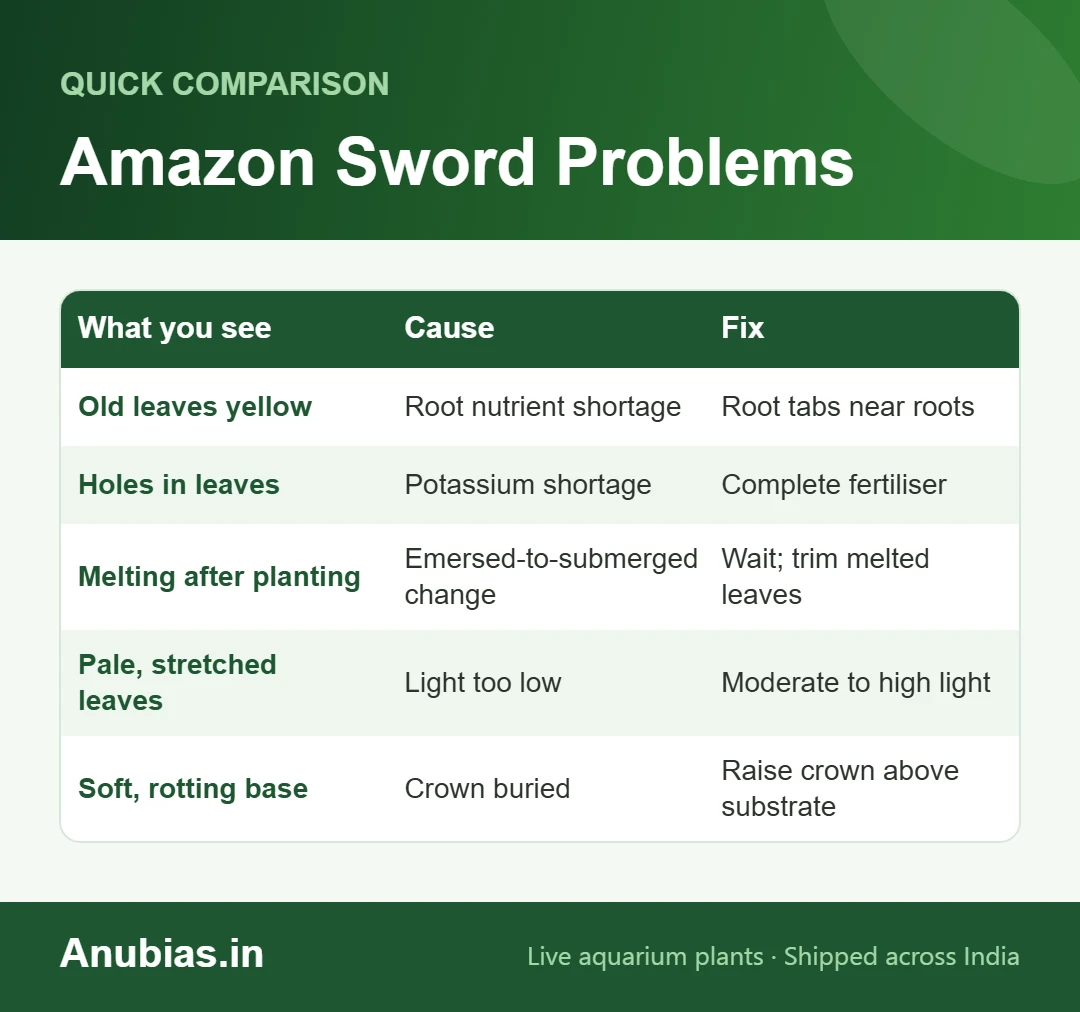
Quick answer: Amazon sword leaves usually turn yellow because the plant is short of nutrients at the roots; push root tabs into the substrate near its roots every 1–2 months. Holes often mean potassium shortage, pale stretched leaves mean too little light (it needs moderate to high light), and melting soon after planting is normal adjustment from emersed growth. Keep the crown just above the substrate, at 22–28 °C and pH about 6.5–7.5.
Why Amazon sword leaves turn yellow
Root feeding is the single most important habit for swords. In plain gravel or an exhausted substrate, older leaves yellow as the plant pulls nutrients from them to grow new ones. Root tabs placed near the roots fix this in most tanks, with a liquid fertiliser for overall health. See root tabs vs liquid fertiliser.
Holes and brown spots
Pinholes that grow on older leaves usually point to potassium shortage. Dose a complete liquid fertiliser. Remove heavily damaged leaves at the base; new leaves will grow in healthy.
Melting after planting
Swords are often grown emersed by nurseries, and those leaves are replaced underwater. Some melting in the first weeks is normal. Trim melted leaves, leave the roots undisturbed and add a root tab. See why new plants melt.
Planting and light checklist
- Keep the crown, where leaves meet roots, just above the substrate; a buried crown rots.
- Give moderate to high light; CO2 is not required but speeds growth.
- Keep water at 22–28 °C with pH around 6.5–7.5.
- Leave space: swords grow into large rosettes.
More in the Amazon sword care guide.
Work out the cause in the right order
Yellowing, holes and melting all look alike from the front glass, so check things in an order that rules out the cheap fixes first.
- Which leaves are affected? Old outer leaves yellowing while the centre pushes new growth is a feeding issue. New leaves coming out pale or small is a light or trace element issue.
- How long has the plant been in the tank? Under a month, and you are almost certainly watching transition rather than a problem.
- Is the crown visible? Run a finger around the base. A crown buried under gravel is the one cause that gets worse no matter how you feed it.
- Are the roots white and firm, or brown and mushy? Lift a small section of substrate at the edge to check without pulling the plant out.
- Only after all of that, look at the water column and your dosing.
Working in this order stops people from buying three bottles of fertiliser to solve a plant that was simply planted too deep.
Swords in Indian tap water and summer heat
Amazon swords handle hard Indian tap water better than most people expect, so a high reading on a test strip is rarely the cause of yellowing. What they handle less well is the combination of high temperature and a nutrient-poor substrate.
Above roughly 30 degrees the plant respires harder and burns through stored reserves, which is why sword problems cluster in April and May. Older leaves go first. Keep a fan across the surface through the hottest weeks and top up with dechlorinated water, because evaporation in a hot flat can be surprisingly fast.
Hard water does have one real effect: it tends to leave a chalky film on older sword leaves near the surface, which blocks light and makes the leaf look dull and yellow before it actually is. Wiping a leaf gently between two fingers tells you whether you are looking at deposits or genuine yellowing.
During the monsoon, watch for a sudden drop in light from overcast weeks if your tank also catches ambient daylight. A sword that was coasting on window light will stall once the sky stays grey.
Plants in this guide
![Green Plus + Trace Fertilizer [ 250ML + 250ML ]](https://anubias.in/wp-content/uploads/2026/04/1000647632-513x654.jpg)
![Green Plus + Trace Fertilizer [ 250ML + 250ML ]](https://anubias.in/wp-content/uploads/2026/04/1000647617-513x729.jpg)
₹ 410 ₹ 580
₹ 250 ₹ 410
Price range: ₹ 90 through ₹ 250
Frequently asked questions
Should I cut yellow Amazon sword leaves?
Yes, once a leaf is mostly yellow, cut it at the base. It will not turn green again.
How often should I add root tabs for a sword?
Every couple of months, or as the product directs, pushed deep near the roots.
Why is my Amazon sword sending out runners?
Runners with baby plants are a sign of a healthy sword. Let them root or replant them elsewhere.
Buy Amazon Sword on Anubias.in.
How large does an Amazon sword get in a two foot tank?
Big enough to dominate it, which is the honest answer. A well-fed sword throws leaves 30 to 45 centimetres long and a rosette wide enough to shade everything behind it. In a two foot tank, plant one as a centrepiece towards the back, or choose a smaller relative if you want room for anything else.
Can I grow an Amazon sword in sand?
Yes, sand works fine as long as you feed the roots. Plain sand holds no nutrients at all, so root tabs pushed down near the root zone are essential rather than optional. Use a reasonable depth, around 5 centimetres, so the roots have somewhere to anchor.
My sword has not produced a new leaf in a month. Is it dying?
Not necessarily, but it is telling you something. A healthy sword in a fed substrate usually opens a new leaf every one to three weeks, so a full month of nothing points to exhausted substrate, a buried crown or too little light. Check the crown first, then add root tabs and give it three to four weeks before judging the result.