
Lighting Secrets for Anubias Nana White: Finding the Perfect Balance for Color and Health

Lighting is the single most critical, and often misunderstood, element in successfully cultivating the rare Anubias Nana White. Unlike almost any other plant in your aquarium, its needs are a paradox: too much light causes algae and burns, while too little light erases its signature white color. In this guide, we will unveil the secrets to achieving that perfect balance, ensuring your prized plant remains healthy, vibrant, and brilliantly white.
Why Standard Lighting Advice Fails for Anubias Nana White
Most aquarium lighting guides focus on providing enough energy for robust photosynthesis. However, Anubias Nana White has almost no chlorophyll, the engine for this process. It cannot handle the same amount of light energy as its green counterparts. Applying standard “medium” or “high” light settings will quickly lead to disaster.
- The Burn Risk: The white leaf tissue lacks the protective green pigments that shield a plant from intense light. Direct, high-intensity lighting acts like a severe sunburn, causing the delicate leaves to melt and decay.
- The Algae Magnet Problem: Because the plant grows incredibly slowly, its leaves are prime real estate for algae. Under strong light, algae will grow much faster than the plant can defend itself, quickly coating the beautiful white leaves in an unsightly green or brown film. Our guide to removing algae is essential reading if this occurs.
The “Greening” Phenomenon: The Plant’s Cry for Help
The opposite problem is just as common. If you, fearing algae, provide too little light, the plant’s survival instincts take over. It will begin producing chlorophyll to capture every available photon of light, causing its leaves to develop a green tint and lose their value. This is the plant telling you it is starving for energy. If this is happening to you, our detailed guide on why Anubias Nana White turns green provides a complete recovery plan.
Finding the Sweet Spot: Practical Lighting Strategies
The goal is to provide gentle, consistent, and indirect light. Here’s how to achieve that in a real-world aquarium setup:
1. Strategic Placement
Where you place the plant is your most powerful tool. Never place Anubias Nana White in an open, unshaded area directly under your light fixture.
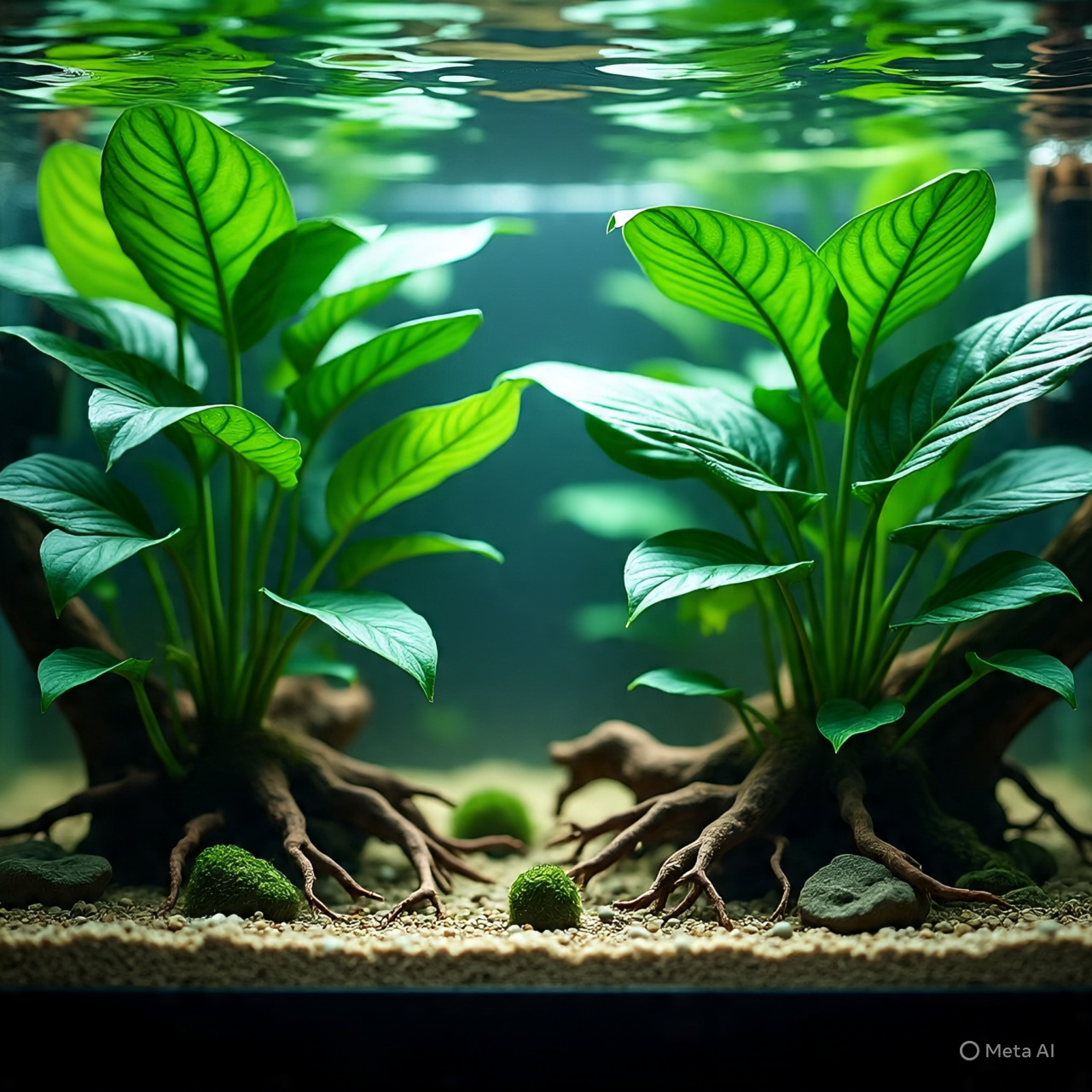
- Under Overhangs: Tuck the plant under a piece of driftwood, a rock ledge, or beneath the leaves of larger, taller plants. This creates natural shade, diffusing the light that reaches it.
- At the Edges of the Tank: The light intensity is often lower at the front and side edges of an aquarium. Placing it here, away from the central “hotspot” of the light, can be very effective.
2. Using a Dimmable Light
A high-quality, dimmable LED light is the best investment for a tank with Anubias Nana White. It gives you precise control.
- Target PAR Levels: If you have a PAR meter, aim for a reading of 20-40 µmol/m²/s at the plant’s leaf level. This is the ideal range for providing enough energy without overwhelming the plant.
- No PAR Meter? No Problem: Start with your light at a very low setting (around 25-30% intensity ) and observe the plant for two weeks. If you see any hint of greening, increase the intensity by 5%. If you see any spot algae, decrease it by 5%. This slow, observational method allows you to find the perfect balance for your specific setup.
3. Control the Photoperiod
The duration of light is just as important as the intensity. Do not run your lights for 10-12 hours. A shorter, consistent photoperiod is much safer.
- Recommended Duration: A photoperiod of 6 to 8 hours is ideal. This provides the plant with enough time to photosynthesize while limiting the window of opportunity for algae to grow.
- Use a Timer: Consistency is key. Use an automatic timer to ensure the lights go on and off at the same time every single day. This contributes to the stable environment that this delicate plant craves. For more on stability, see our Ultimate Care Guide.
Mastering the lighting for Anubias Nana White is a rewarding process. It requires patience and careful observation, but the reward is a stunning, brilliantly white plant that serves as the undisputed centerpiece of your aquascape. By treating light as a precise tool rather than a blunt instrument, you can unlock the full potential of this rare aquatic jewel.